
States vs robocalls
Policy Approaches
for State Legislatures
For decades, the Federal Communications Commission (FCC) has grappled with the persistent problem of illegal and unwanted calls and texts. This is far more than a simple nuisance; it’s a significant issue leading to consumer annoyance, financial loss, and even identity theft.
While historical approaches, notably under the federal Telephone Consumer Protection Act (TCPA), relied heavily on compliance obligations and robust private rights of action, this litigation-centric model has unfortunately had significant unintended consequences.
The reality is that relying primarily on private lawsuits, often triggered by aggressive plaintiffs’ lawyers leveraging high statutory damages, has become a “cash cow”. This litigation frequently targets legitimate businesses, including those who have obtained consent, rather than the actual scam artists who operate outside the law.
State Mini-TCPA Laws Fail to Address Core Issue of Spam and Scam Texts
States have exacerbated the problem in recent years by adopting their own “mini-TCPA” laws. “Mini-TCPA” laws, while well-intentioned, are not proving effective at stopping actual spam and scam calls and texts. Data indicates that lawsuits under these state laws are predominantly filed against businesses who had consent but were targeted based on a unique state-specific requirement, essentially providing a payday for lawyers rather than deterring bad actors.
These state statutes often create a fragmented regulatory patchwork that causes “compliance nightmares” for businesses operating across state lines. They run into significant technical hurdles, such as the practical impossibility for businesses to determine a mobile phone user’s real-time physical location due to federal Customer Proprietary Network Information (CPNI) rules. This makes location-based rules, like “quiet hours” tied to the recipient’s time zone, practically impossible to comply with.
Furthermore, some state laws impose restrictions that conflict with federal law, even when a consumer has provided consent, overriding consumer intent and hindering legitimate business communication. Others include technical requirements for text messaging that simply don’t align with modern operational realities, like requiring an individual’s first and last name to be included in a business’s text messages.
These inconsistencies and technical misalignments, coupled with private rights of action and statutory damages, create an environment ripe for “shakedown” lawsuits.
Recognizing the limitations of this after-the-fact, litigation-heavy model, the FCC has fundamentally shifted its strategy, particularly over the last five years. The Commission’s approach is now a multifaceted attack and a technical fight, centered on implementing technical and procedural changes within the telecommunications network itself.
This deep dive into technical controls is showing positive results. According to data reported by the Federal Trade Commission (FTC), since the FCC shifted its approach around 2020, the number of consumer complaints regarding unwanted calls has decreased by more than 50%.
Ready to learn more? Download our States vs. Robocalls: Policy Approaches for State Legislatures book below to continue reading.
Have questions for EIA? We welcome you to contact us to discuss how we can help.
Download OUR FREE BOOK
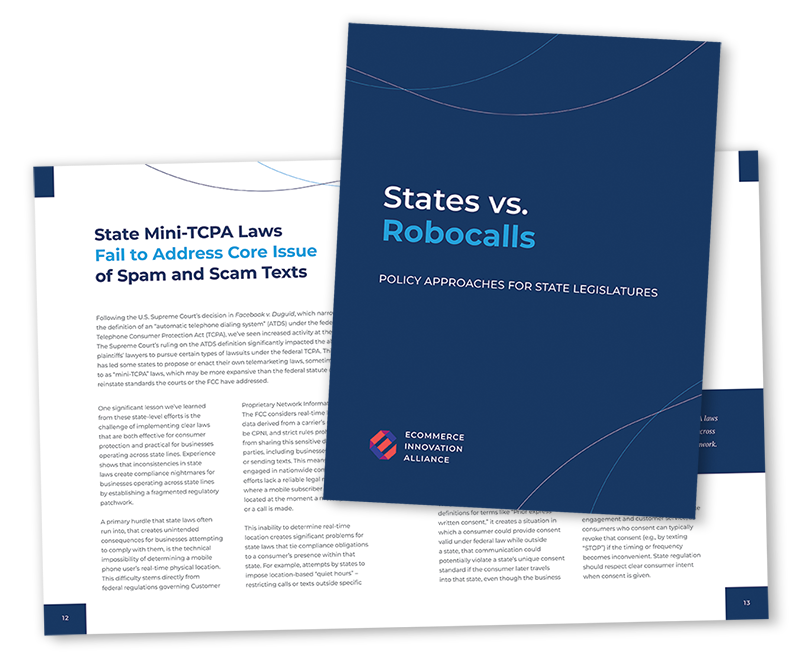
States vs. Robocalls
Discover how your state can truly curb illegal robocalls and scam texts without inadvertently harming legitimate businesses. Our new 24-page book States vs. Robocalls: Policy Approaches for State Legislatures is the definitive guide for strategic legislative action in the fight against unwanted spam and scam messages.
States vs. Robocalls empowers state legislatures to make a real impact by providing a strategic path forward that avoids the pitfalls of individual state “mini-TCPA” laws. Request your free PDF copy today using the form below.
Download the States vs. Robocalls Book
Learn more about the TCPA and it’s abuse, how the FCC is fighting against illegal calls and texts, and how you can make more informed policy decisions with EIA’s informative new book States vs. Robocalls: Policy Approaches for State Legislatures. Complete the form below for instant access to download your complimentary PDF copy.