
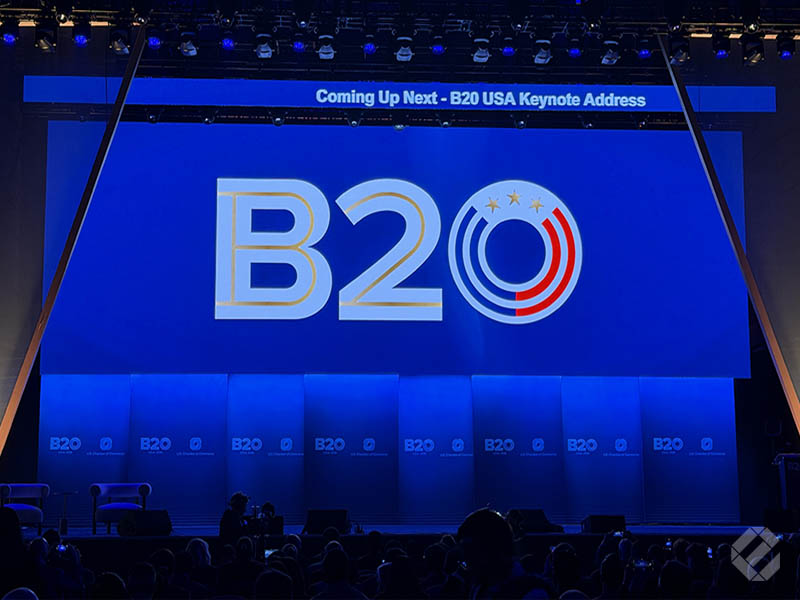
This week, the U.S. Chamber of Commerce hosted the 2026 B20 Summit in Washington, D.C., the first time the G20’s official business forum has met in the United States. Business leaders and policymakers from around the world gathered at the Wharf to discuss investment, energy security, innovation and global growth. EIA President and CEO David Carter was invited to attend on behalf of our members.
A global agenda for growth
The B20 was founded after the 2008 financial crisis to give the private sector a formal voice in the G20, and this year’s summit was the culmination of a year of task-force work led by business leaders from companies including Citadel, Dow, GE Vernova and Amazon. U.S. Chamber President and CEO Suzanne P. Clark opened the main program with the B20 keynote, followed by a conversation on the summit’s agenda with former Congressman Kevin Brady, who helped lead the B20’s work, and a welcome from the White House Office of Public Liaison.
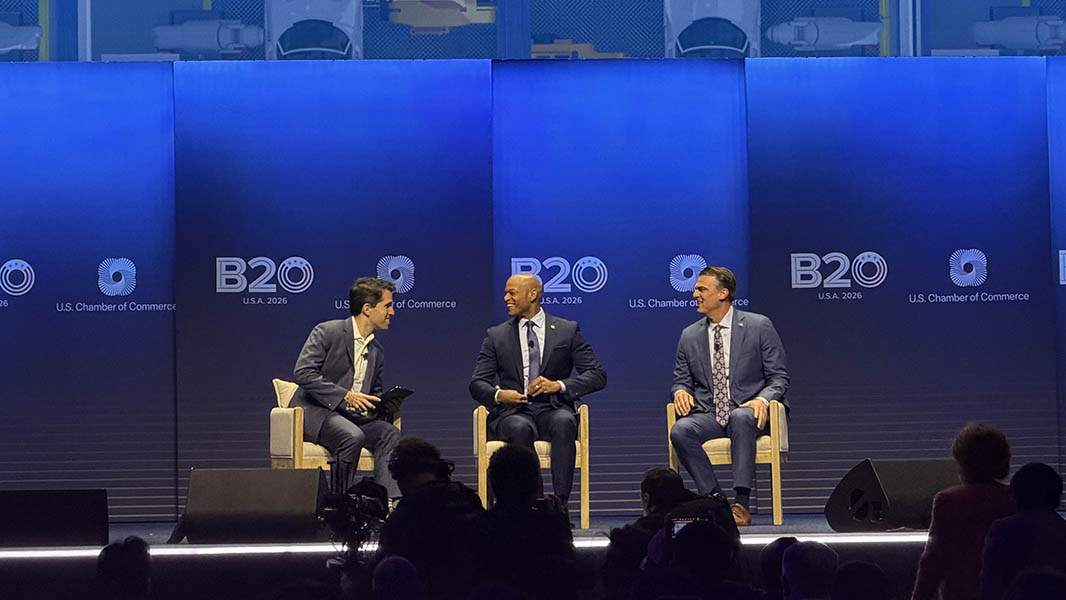
Governors on policy. One of the highlights of the opening day was a bipartisan conversation on driving foreign direct investment between Maryland Governor Wes Moore and Oklahoma Governor Kevin Stitt, moderated by POLITICO’s Alexander Burns. The pairing underscored that competing for global investment, jobs and growth is a priority shared across party lines and across very different state economies. The Governors also shared their candid assessment on the mid-term elections, the voter frustrations on the economy and perceived corruption, and President Trump’s decision to replace Susie Wiles with Stephen Miller as his Chief of Staff. For those interested, you can watch the replay here.
Business leaders on the global economy. Executive panels brought together leaders including Dow’s Jim Fitterling, UPS’s Carol Tomé, Allstate’s Tom Wilson, GE Vernova’s Scott Strazik, Docusign’s Allan Thygesen and Mastercard’s Richard Verma. They discussed growth in an age of uncertainty, energy security and the next drivers of growth. Former National Economic Council Director Gary Cohn, now Vice Chairman of IBM, offered his view of global markets, and ambassadors from France, Germany, Italy and Canada set out a G7 roadmap for growth.
Alongside the main program, working sessions covered issues that matter to businesses operating across borders. One was especially relevant to our members: how America’s litigation model is spreading to other countries.
The globalization of litigation
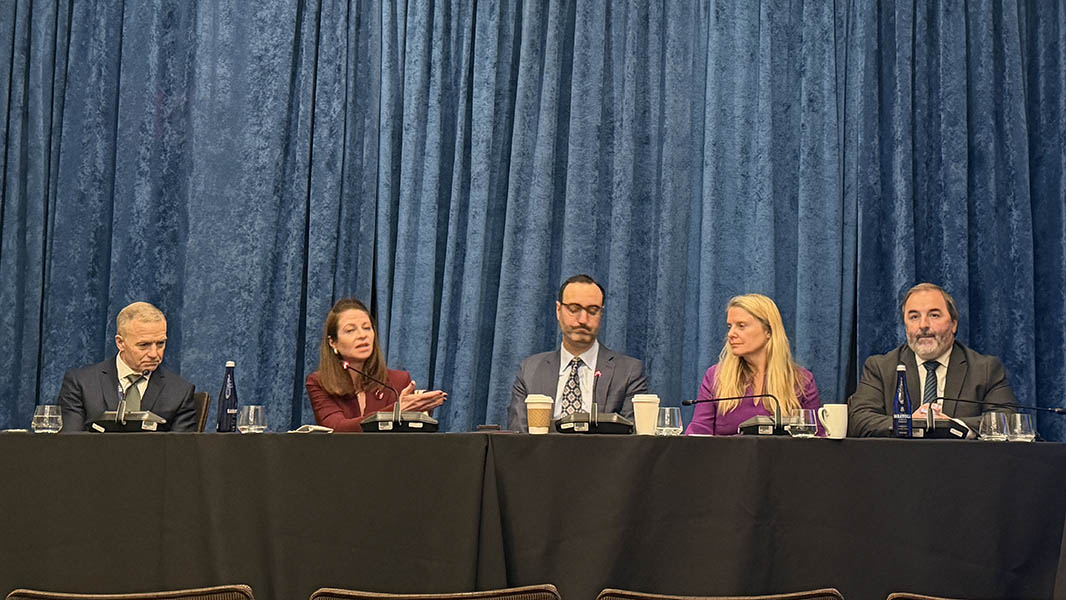
Legal risk no longer stops at national borders. That was the premise of the working session “The Globalization of Litigation: Navigating the New Transatlantic Legal Landscape,” which was the primary focus of EIA’s attendance. This session dug into how American-style litigation trends and liability frameworks are crossing the Atlantic. The panel brought together current and former members of the UK and European Parliaments. Panellists included Seema Kennedy, a former Member of the UK Parliament and now Executive Director of Fair Civil Justice, and Paulo do Nascimento Cabral, a Member of the European Parliament from Portugal (European People’s Party) who sits on the Parliament’s Delegation for relations with the United States.
The panellists discussed what is driving the export of U.S. legal practices to the UK, the EU and beyond, including opt-out class actions, third-party litigation funding and aggressive recruitment of claimants. They assessed the growing risks for businesses operating across borders, and set out practical strategies to protect innovation and economic growth from predatory litigation.
The conversation matters for our members. Many of the ecommerce businesses EIA represents have first-hand experience of the U.S. class action system. They know what happens when litigation becomes a business model in itself.
The numbers behind the trend
The U.S. Chamber’s Institute for Legal Reform recently published International Tort Costs, a comparative study prepared by the Insurance Information Institute. It compares the United States, the United Kingdom, the five largest EU economies, Australia and Canada. Its findings show why policymakers abroad should pay attention:
• The U.S. remains the most expensive tort system studied. Tort costs reached 2.15% of GDP in 2023, about $580 billion and nearly three times the average across the jurisdictions studied.
• The UK is catching up fast. UK tort costs more than doubled as a share of GDP between 2014 and 2023, from 0.57% to 1.22%, the fastest growth of any jurisdiction studied. On current trends, the report projects that the UK will match the U.S. as a share of GDP by around 2029–2030.
• Collective actions and litigation funding are key drivers. The report points to the UK’s opt-out collective action regime for competition claims, introduced by the Consumer Rights Act 2015. It also cites third-party litigation funding and loose certification standards.
• Reform works. Canada’s tort costs declined after Ontario reformed its class action rules in 2020.
The UK is now considering opt-out consumer class actions
In April 2026, the Law Commission of England and Wales announced a project, sponsored by the Department for Business and Trade, to consider whether to introduce an opt-out class actions regime for consumer claims and how such a regime should be designed. The UK’s existing opt-out regime is largely confined to competition claims in the Competition Appeal Tribunal. A general consumer regime would greatly expand its reach to everyday consumer law, including the marketing, privacy and online sales practices that ecommerce businesses rely on.
The Commission issued an initial scoping questionnaire in the spring and expects to publish a formal consultation paper. The project runs alongside a separate government review of the Tribunal’s opt-out regime and continuing debate about how litigation funding should be regulated.
EIA has submitted a response to the Law Commission’s questionnaire, drawing on our members’ first-hand experience of the U.S. opt-out class action system. We acknowledged that opt-out claims can, in principle, deliver redress for small individual losses. But we urged the Commission to treat the U.S. as a cautionary tale. For the small and mid-sized online businesses we represent, most demand letters and lawsuits exist to benefit serial plaintiffs and their lawyers, not to redress real consumer loss.
Our submission highlighted how U.S. firms recruit plaintiffs through social media ads and send templated demand letters in bulk. It showed how they use decades-old statutes to target everyday website tools, and how they extract quick settlements on claims they never intend to take to certification. Of the 5,114 website accessibility lawsuits filed in 2025, 70% targeted ecommerce businesses and 64% targeted companies with revenue under $25 million. Meanwhile, lawyers routinely take a quarter to a third of consumer settlements, while consumers recover a few dollars each.
If the Commission recommends a regime, we urged strong safeguards. Our recommendations were:
• compensation for actual loss only, with no statutory damages for technical violations
• a notice-and-cure period before claims can be filed
• keeping the English ‘loser pays’ rule
• lawyers’ fees and funder returns tied to what consumers actually receive
• a process for declaring class claimants and their law firms ‘vexatious collective litigants’, with consequences for lawyers who file putative class actions but never pursue certification
Learning from the U.S. experience
U.S. states are already working to fix these problems. After Illinois limited damages under its biometric privacy law in 2024, class action filings under the statute fell from 427 in 2024 to 150 in 2025. Missouri and Florida have adopted notice-and-cure requirements to curb abusive suits. The UK should not import a system that American legislators are actively working to repair.
As the UK takes up the B20 presidency, the Law Commission’s work is only beginning. EIA will continue to engage with policymakers in Washington, London and Brussels to make sure the voices of small and mid-sized online businesses are heard.