
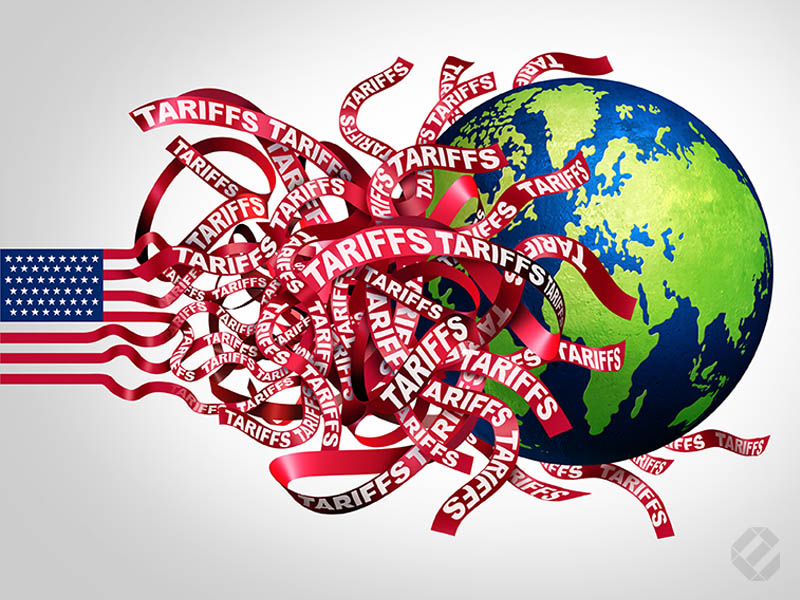
On July 24, 2026, the Trump Administration’s temporary Section 122 tariffs expired after reaching their 150-day statutory limit. But rather than allowing those tariffs to lapse, the Administration announced a replacement program one day earlier under Section 301 of the Trade Act of 1974.
How We Got Here
This latest development is the result of several months of legal and policy changes.
Earlier this year, the Administration imposed broad tariffs under the International Emergency Economic Powers Act (IEEPA). Those tariffs were ultimately struck down after courts concluded that IEEPA did not authorize the President to impose tariffs in this manner.
To keep tariffs in place while pursuing another approach, the Administration turned to Section 122 of the Trade Act of 1974, a provision that allows the President to temporarily impose tariffs to address balance-of-payments concerns. However, Congress limited that authority to 150 days, meaning the Section 122 tariffs automatically expired on July 24, 2026.
Before that deadline arrived, the U.S. Trade Representative (USTR) completed a series of investigations under Section 301 of the Trade Act of 1974 related to alleged unfair trade practices and forced labor concerns involving numerous U.S. trading partners. On July 23, USTR announced a new tariff program under Section 301, which took effect the following day.
What’s the Difference Between Section 122 and Section 301?
Although both authorities allow the government to impose tariffs, they serve different purposes.
| Section 122 | Section 301 |
| Temporary emergency authority | Longstanding trade enforcement authority |
| Limited by Congress to 150 days | Can remain in effect much longer |
| Intended to address balance-of-payments concerns | Used to respond to unfair foreign trade practices |
| Broad temporary measure | Requires investigations and administrative procedures before tariffs are imposed |
| Expired automatically on July 24 | Forms the legal basis for the current tariff program |
| Applied as a uniform 10% surcharge on imports from every country, with no country-specific list | Targets 60 named economies at 10% or 12.5%, based on individual forced-labor findings |
The tariffs themselves largely remain—but the legal authority behind them has changed.
Which Countries Are Covered—And at What Rate?
Section 122’s 10% surcharge was a blanket measure—it applied to imports from virtually every country, with no country-by-country findings involved. The new Section 301 program works differently. Rather than a uniform global rate, USTR built its case country by country, targeting economies it determined had failed to ban goods made with forced labor, or had failed to enforce bans they already have on the books.
The result affects 60 economies that, according to a USTR fact sheet, together account for roughly 99.4% of U.S. imports—so in practical terms, the new tariffs’ reach comes close to matching Section 122’s near-universal coverage, just under a different legal theory. Named economies include the European Union, United Kingdom, Canada, Mexico, China, Japan, India, South Korea, Vietnam, Brazil, and dozens of others spanning nearly every region that trades with the U.S.
Rates aren’t uniform, though. Most of the 60 economies face a 12.5% duty. A smaller group of roughly 17—including Canada, the United Kingdom, India, and Mexico, along with several Latin American and Southeast Asian countries—pay a lower 10% rate because USTR found they already ban forced-labor imports, have committed to doing so through a trade agreement, or maintain a partial enforcement regime. The EU, Japan, South Korea, Taiwan, and Switzerland fall under a related rule: their Section 301 duty applies only to the extent their existing tariff rate sits below 10%, which effectively caps how much the new tariff adds.
Why the Inclusion of Allies Like the UK, Canada, the EU, and Japan Sparked Pushback
What drew the most criticism wasn’t the tariffs on economies more commonly associated with forced-labor risk in global supply chains—it was USTR’s finding that close U.S. allies and top trading partners had also failed to meet the standard. Ambassador Jamieson Greer framed the action as overdue accountability, arguing that “decades of moral suasion have not eradicated forced labor from global supply chains.” Officials from several affected governments pushed back hard on that framing.
Canada, which received the lower 10% rate, noted that the timing was not unexpected given that the tariffs took effect right as the prior Section 122 surcharge lapsed. But Minister Dominic LeBlanc pushed back on the underlying premise, describing Canada’s existing legal and enforcement framework against forced labor as among the most robust in the world.
The European Union‘s response, as reported by Al Jazeera, combined reassurance with objection: the European Commission called the tariffs unjustified while reaffirming its commitment to the trade agreement reached with Washington in July 2025, which caps most U.S. tariffs on EU goods at 15%. European lawmakers were more pointed—the chair of the European Parliament’s trade committee dismissed USTR’s forced-labor finding as “utterly absurd.”
Japan‘s Chief Cabinet Secretary, Minoru Kihara, called the move “regrettable,” arguing that Japan’s industry and trade practices already align with international rules. The United Kingdom government offered a more muted reaction, saying the tariffs would have little effect on its export economy—consistent with the UK landing in the lower 10% tier.
Other trading partners were blunter still: New Zealand’s prime minister called the tariffs on his country extremely disappointing, and Australia’s trade minister described them as completely unjustified. The breadth and tone of the pushback underscore a point relevant to ecommerce sellers well beyond these four economies—USTR’s forced-labor rationale is being applied broadly enough that few sourcing regions are likely to be entirely insulated from it.
The Legal Challenges Started Immediately
The shift to Section 301 did not end the legal battle. Within hours of the new tariffs taking effect, multiple lawsuits were filed in the U.S. Court of International Trade by importers challenging the Administration’s latest tariff program. Among those bringing suit are businesses represented by the Liberty Justice Center, as well as Learning Resources and other import-dependent companies.
The plaintiffs argue that simply changing the statutory authority does not automatically make the tariffs lawful. They contend the Administration exceeded the authority Congress granted under Section 301 and failed to satisfy certain statutory requirements before imposing broad tariffs across multiple countries.
The Administration disagrees, maintaining that it followed the investigative and procedural requirements required under Section 301 before implementing the new tariff program.
For now, the tariffs remain in effect while the litigation moves forward.
Why Ecommerce Businesses Should Care
As we’ve previously discussed in our coverage of tariffs, de minimis reform, and trade policy, uncertainty itself carries real costs for online sellers.
Many ecommerce businesses have spent the past year and a half adapting to rapidly shifting trade policies. Some diversified manufacturing outside China. Others adjusted pricing strategies, renegotiated supplier relationships, or explored alternative sourcing destinations throughout Asia and North America.
At the same time, businesses have also been navigating changes to de minimis eligibility, increased customs enforcement, and rising shipping costs. This latest development means uncertainty remains.
Although the Administration has moved to what many view as a more established legal authority for tariffs, the new lawsuits mean businesses still cannot assume the legal landscape has settled. Future court decisions could affect sourcing strategies, import costs, and long-term planning.
The EIA’s Perspective
The Ecommerce Innovation Alliance has consistently advocated for trade policies that provide ecommerce businesses with predictability and transparency. Whether businesses support or oppose particular tariffs, they need stability through clear rules that allow them to make informed decisions about sourcing, inventory management, pricing, and long-term investment. Frequent changes in tariff policy—combined with ongoing litigation challenging those changes—make planning significantly more difficult, particularly for small and medium-sized ecommerce businesses that often have fewer resources to absorb unexpected cost increases.
What Happens Next?
The new Section 301 tariffs remain fully in effect while the lawsuits proceed through the courts. At this stage, there is no injunction preventing enforcement, and businesses should continue complying with current tariff requirements unless and until a court rules otherwise.
The litigation could take months to resolve, and additional legal challenges are possible as the Administration continues implementing its broader trade agenda.
Join the EIA today to help strengthen and shape policies that affect all ecommerce businesses. Together, we can continue to create the future of ecommerce. Subscribe to EIA email updates to stay informed on key developments and their impact on your business.
Ecommerce Innovation Alliance provides members with analysis of litigation and regulatory developments affecting online commerce and digital marketing. This post is for informational purposes only and does not constitute legal advice.