In a sweeping and long-awaited decision issued today, the United States Supreme Court held that the International Emergency Economic Powers Act (IEEPA) does not authorize the President to impose tariffs. The ruling in Learning Resources, Inc. v. Trump (consolidated with Trump v. V.O.S. Selections, Inc.), decided 6-3, represents one of the most significant trade law decisions in decades—and a major victory for ecommerce businesses and the consumers they serve.
The Ecommerce Innovation Alliance (EIA) has been closely tracking these cases for over a year, filing amicus briefs, monitoring lower court proceedings, and advocating before policymakers. Today’s decision validates the legal arguments we and others have raised: that the President’s sweeping tariff regime—justified solely on the basis of IEEPA—lacked any legitimate statutory foundation.
“Today’s Supreme Court decision is a historic vindication for ecommerce businesses and the millions of American consumers who have been bearing the cost of unlawful tariffs. The Court has made clear what EIA has argued from the beginning: the President cannot use a national security statute as a blank check to impose sweeping taxes on imported goods. We are gratified that the Court reaffirmed that the power to tax belongs to Congress, not the Executive.”
— David Carter, President & CEO, Ecommerce Innovation Alliance
Background: The Road to the Supreme Court
The Trump administration’s use of IEEPA to impose broad tariffs on goods from China, Canada, Mexico, and dozens of other countries set off an unprecedented wave of litigation. IEEPA, enacted in 1977, grants the President authority to “regulate” international commerce in response to a declared national emergency. The administration contended this statutory language was broad enough to encompass the imposition of tariffs—including the sweeping “Liberation Day” tariffs announced in April 2025 and the elevated duties on Chinese goods.
Courts were initially divided. The U.S. Court of International Trade struck down the tariffs. The D.C. Circuit reached a different conclusion on jurisdictional grounds. The Federal Circuit, sitting en banc, ultimately affirmed the lower court’s invalidation of the tariffs. The Supreme Court granted certiorari to resolve the conflict, and today issued its definitive ruling.
The Justices Had a Lot to Say
In a telling sign of just how consequential today’s ruling is, nearly every faction of the Court felt compelled to write separately with the total opinion spanning 170 pages. Chief Justice Roberts authored the principal opinion, but he was joined by a patchwork of concurrences rather than a unified majority voice: Justice Gorsuch wrote a concurrence, Justice Barrett penned her own concurrence; and Justices Kagan, Sotomayor, and Jackson — representing the Court’s liberal wing — concurred in the judgment but through a different analytical path. Even the three dissenters offered two different dissenting opinions with Justices Kavanaugh, writing one that was joined by Thomas and Alito, and Justice Thomas finding a need to write a second dissent on his own. Six distinct opinions in a single case reflects the reality that the Court was not just deciding a trade dispute. It was staking out the boundaries of presidential power in the modern era, and every Justice appeared to feel the weight of that task.
The Majority Opinion
Writing what is the binding decision for the Court, Chief Justice Roberts grounded the decision in two mutually reinforcing pillars: the major questions doctrine and ordinary statutory interpretation.
On the major questions doctrine, the Court held that imposing tariffs of unlimited scope and duration on the entirety of U.S. imports is a question of such “vast economic and political significance” that the President must point to “clear congressional authorization” in IEEPA. No such authorization exists. Congress has historically treated tariff authority as its own prerogative, delegating it only through specific, carefully defined statutes. The idea that Congress silently empowered the President to upend the entire U.S. tariff regime through a single ambiguous phrase in a 1977 national security statute “strains credulity,” the Court wrote.
On the textual question, the Court held that the power to “regulate…importation” in IEEPA does not include the power to impose tariffs. The Court drew a sharp distinction between “regulation” and “taxation”—both in constitutional doctrine and in the way Congress drafts trade legislation. Statutes that authorize tariffs say so explicitly; IEEPA “contains no reference to tariffs or duties.” The Court also noted that no President prior to 2025 had ever invoked IEEPA to impose tariffs, a powerful indicator that the statute was not understood to confer such authority.
The Concurrences
Justice Gorsuch joined the principal opinion in full and wrote separately to emphasize the constitutional dimension: Congress cannot delegate away the legislative power to tax, and courts should be especially skeptical of claimed executive authority to impose what are functionally revenue measures.
Justice Barrett concurred in the judgment, writing that the major questions doctrine is simply a tool of ordinary statutory interpretation—not a separate “super-canon”—but agreed that IEEPA’s text plainly does not authorize tariffs.
Justices Kagan, Sotomayor, and Jackson concurred in the judgment, reaching the same result through straightforward statutory interpretation without relying on the major questions doctrine. They emphasized that Congress knows how to delegate tariff authority when it wants to, and the absence of any such language in IEEPA is decisive.
Two Dissents
Two written dissents were filed. Justices Kavanaugh wrote the primary dissent in which Justices Thomas and Alito joined. Justice Kavanaugh’s argument is that IEEPA’s broad text—granting the President authority to “regulate…importation”—is broad enough to encompass tariffs, particularly given the sweeping nature of the emergency powers Congress has historically conferred on the President in the national security context. Justice Thomas wrote an additional dissent in which no other justice joined. He wrote separately to argue that interpreting IEEPA to allow the President to unilaterally impose tariffs would not violate the separation of powers because, in his view, there was sufficient history to conclude that the imposition of tariffs was an area that the founding fathers would have permitted Congress to delegate to the President.
The Judgments
The Court affirmed the Federal Circuit’s judgment striking down the tariffs. In the D.C. Circuit case, the Court vacated the judgment and remanded with instructions to dismiss for lack of subject matter jurisdiction—confirming that tariff challenges must be brought in the Court of International Trade, not in the D.C. federal courts.
What the Decision Means for the De Minimis Exception
EIA members and the broader ecommerce industry will rightly ask: does this ruling resolve the separate but deeply related fight over the de minimis exception under 19 U.S.C. § 1321?
The short answer is that the Court did not directly address de minimis. The majority opinion explicitly cabined its holding: “We decide only whether the power to ‘regulate…importation,’ as granted to the President in IEEPA, embraces the power to impose tariffs. It does not.” The Court expressly declined to “set forth the metes and bounds” of IEEPA’s broader regulatory authority.
That said, today’s decision has powerful implications for the de minimis litigation currently pending before the Court of International Trade. The Trump administration suspended the de minimis exemption for Chinese-origin goods pursuant to the same IEEPA executive orders that imposed the unlawful tariffs. EIA filed an amicus brief in that litigation arguing the suspension was unlawful, and today’s ruling significantly strengthens that position.
The reasoning cuts in favor of ecommerce businesses on two fronts:
- The IEEPA executive orders suspending de minimis were rooted in the same claimed tariff authority the Court has now rejected. If IEEPA cannot be used to impose tariffs, orders issued under that authority that effectively function as revenue measures—including eliminating an exemption that reduces the tax burden on imports—are on equally shaky legal ground.
- The Court’s broader reasoning—that “regulate” does not mean “tax”—applies equally to the suspension of a statutory tax exemption. Eliminating the de minimis threshold raises revenue for the government just as surely as a tariff does; it is functionally a tax measure, not a regulatory one.
However, the lower courts (and ultimately the Federal Circuit) will need to apply the Supreme Court’s reasoning to the de minimis question directly. That litigation is not over. EIA will continue to monitor these cases and advocate for the swift restoration of the de minimis threshold, which is vital to the functioning of cross-border ecommerce for small businesses and consumers alike.
Will Ecommerce Businesses Receive Tariff Refunds?
Perhaps the most consequential practical question for EIA members is whether businesses that paid IEEPA tariffs will be entitled to recover them. The answer is: potentially yes, but the path is complex and far from automatic.
The Legal Baseline
The Supreme Court has now established that the IEEPA tariffs were unlawful from the start. That means businesses that paid them were paying tariffs that the government had no legal authority to collect. As a general matter, unlawfully collected duties are subject to refund under the customs laws, particularly where a timely protest has been filed with U.S. Customs and Border Protection (CBP).
Who Is Best Positioned for Refunds?
- Businesses that filed timely protests with CBP (generally within 180 days of liquidation of the entry) are in the strongest position to claim refunds. Those protests should now be approved in light of the Supreme Court’s ruling.
- Businesses that are plaintiffs or class members in pending Court of International Trade litigation may also recover through those proceedings.
- Businesses that neither filed protests nor joined litigation face a harder road. The administrative protest period is strict, and absent a legislative remedy or a court-ordered injunction with retroactive effect, they may have limited recourse.
Complicating Factors
Several factors could delay or limit the scope of refunds:
- Scale: The IEEPA tariff regime collected hundreds of billions of dollars. The sheer magnitude of potential refund liability creates powerful institutional pressure on the government to contest or delay payment.
- Congressional action: Congress could legislate to address—or to limit—refund claims, particularly as part of any broader trade policy response to today’s ruling.
- Equitable defenses: The government may raise equitable arguments in individual cases, though these are generally disfavored in customs refund proceedings where the legal right is clear.
- Administrative capacity: Processing a massive volume of refund claims through CBP will take time, and businesses should expect delays even where the legal entitlement is clear.
EIA’s Recommendation
Ecommerce businesses that paid IEEPA tariffs should immediately consult with customs counsel to assess their specific situation. Key steps include reviewing whether protests were filed timely, determining whether entries have been liquidated, and identifying whether any pending litigation provides a vehicle for relief.
What Happens Next?
Today’s decision resolves the core constitutional and statutory question about IEEPA tariff authority, but it opens several new fronts:
- Lower court proceedings: The Federal Circuit’s judgment is affirmed, which means the Court of International Trade will be the center of gravity for ongoing tariff and de minimis litigation. Cases that were stayed pending the Supreme Court’s decision will now proceed.
- Executive response: The administration may seek to re-impose tariffs under different statutory authority, such as Section 232 of the Trade Expansion Act, Section 301 of the Trade Act of 1974, or by seeking new Congressional authorization. EIA will closely monitor any such efforts.
- Congressional action: Congress may act—whether to ratify some form of tariff policy through legislation, to address refund liability, or both. EIA will engage actively with members of Congress on these issues.
Conclusion
Today’s ruling is a landmark moment in U.S. trade law. The Supreme Court has reaffirmed a foundational principle: the power to tax belongs to Congress, not the President, and that power cannot be quietly assumed through a broad reading of an emergency statute. For ecommerce businesses that have struggled under the weight of unlawful tariffs for the past year, the decision offers both legal vindication and practical hope.
EIA will continue to fight for policies that support a thriving, competitive ecommerce ecosystem—including the restoration of de minimis and the prompt processing of tariff refunds. We will be issuing further updates as the legal and policy landscape develops in the days and weeks ahead.
Join the EIA today to help strengthen and shape policies that affect all ecommerce businesses. Together, we can continue to create the future of ecommerce. Subscribe to EIA email updates to stay informed on key developments and their impact on your business.
Watch Webinar Replay
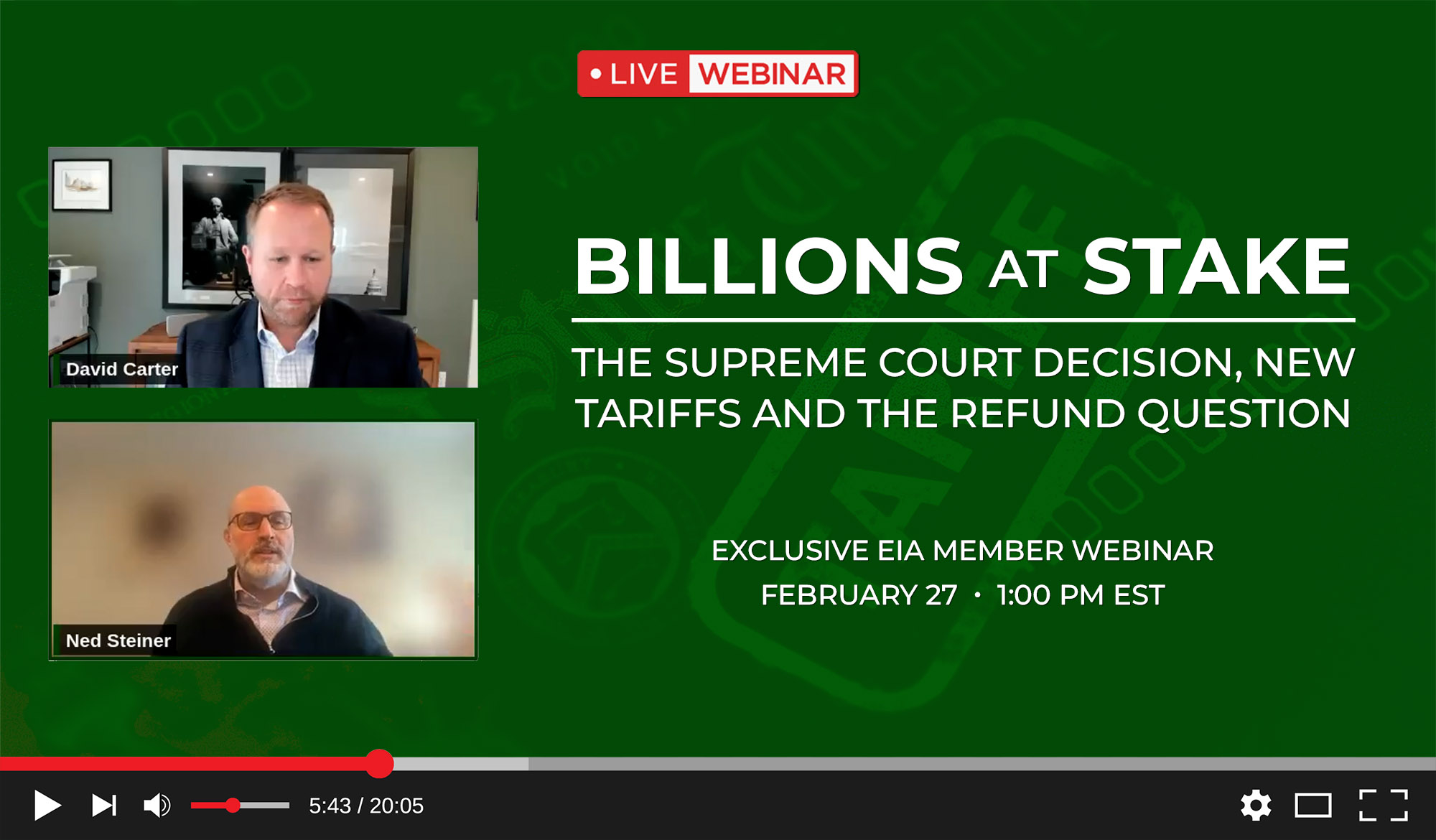
Watch the video replay of our webinar “Billions at Stake: The Supreme Court Decision, New Tariffs and the Refund Question” to learn more about the recent Supreme Court IEEPA decision. We discuss in detail what the Supreme Court’s decision actually changes, how the Administration has responded since, the pathways for potential refunds and much more.