
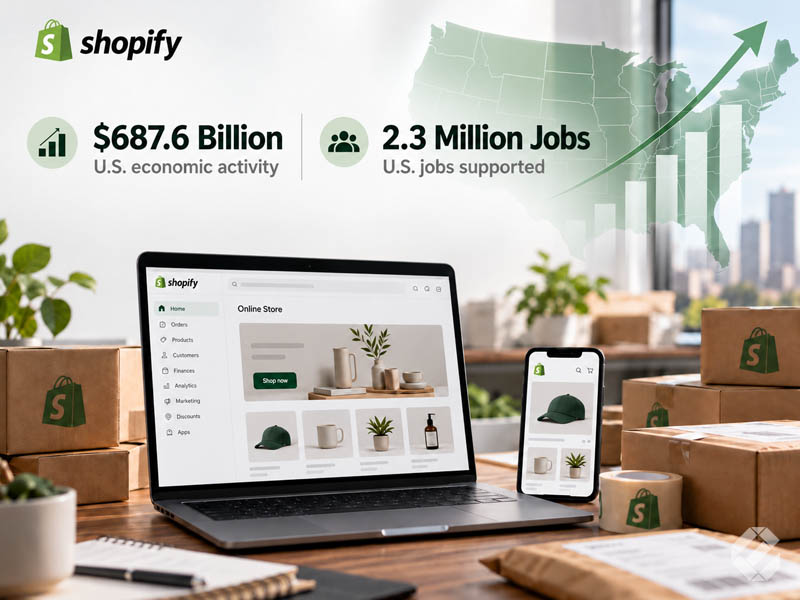
Shopify’s 2026 Entrepreneur Effect report puts a number on the ripple effects of independent commerce. More than half of the global total lands in the United States, and the state-level data tells an even more interesting story.
Shopify has released The Entrepreneur Effect, a global snapshot of entrepreneurship built on platform data, merchant and third-party surveys, and economic-impact modelling. The top-line figure is big: for the year ending June 30, 2026, Shopify’s merchant and partner ecosystem generated more than $1.2 trillion in global economic activity and supported more than 9.6 million jobs worldwide.
But for anyone focused on the US market, the more useful part of the report is near the back, where Shopify breaks its economic impact estimates down by select countries and by US state. Here is what stands out.
The US is the center of gravity
Shopify estimates that its US ecosystem generated $687.6 billion in economic activity and supported 2.3 million jobs over the reporting year. Put in context, that means:
- Roughly 56% of the ecosystem’s global economic activity is in the US. No other market comes close: the UK is second at $94.3 billion, meaning the US figure is more than seven times larger.
- About a quarter of the 9.6 million jobs worldwide are American. The US accounts for 2.3 million, versus 479,000 in the UK and 300,000 in Australia.
- US cross-border sales are up 174% since 2022. That’s solid growth, though several European markets grew faster from smaller bases, including France (314%), Spain (287%), and Germany (283%).
Shopify is careful to say the market table is a snapshot of economic impact, not a ranking of entrepreneurial performance. Still, the scale gap is striking. The US is both the largest consumer market and the largest base of Shopify-powered sellers, and the modelled ripple effects (supplier spending, payroll, and downstream consumption) compound accordingly.
Four states account for half the US total
The state-level table is where the report gets interesting. California alone generated an estimated $173.0 billion in economic activity and supported 573,000 jobs, about one-quarter of the entire US figure. Add New York, Florida, and Texas, and four states account for just over half (about 50.4%) of US economic activity tied to the Shopify ecosystem.
| # | State | Economic activity | Jobs supported | Share of US activity |
| 1 | California | $173.0B | 573K | 25.2% |
| 2 | New York | $75.6B | 253K | 11.0% |
| 3 | Florida | $49.7B | 167K | 7.2% |
| 4 | Texas | $48.2B | 161K | 7.0% |
| 5 | Delaware | $21.3B | 70K | 3.1% |
| 6 | New Jersey | $20.7B | 69K | 3.0% |
| 7 | Utah | $19.4B | 64K | 2.8% |
| 8 | Colorado | $16.7B | 55K | 2.4% |
| 9 | Wyoming | $15.0B | 50K | 2.2% |
| 10 | Illinois | $14.2B | 48K | 2.1% |
Source: Shopify, The Entrepreneur Effect (2026). Figures cover the year ending June 30, 2026. Share of US activity calculated from the state table, which sums to the $687.6B national figure.
A few things jump out from the top ten:
- California is in a league of its own. At $173 billion, it is larger than every country in Shopify’s market table except the US itself, nearly double the UK and more than twice Australia.
- New York outpaces its population. New York ($75.6B) comes in well ahead of Florida and Texas, both of which have larger populations. That likely reflects the density of DTC brands, fashion, and beauty businesses headquartered in and around New York City, with New Jersey ($20.7B) not far behind.
- Florida and Texas are neck and neck. At $49.7B and $48.2B respectively, the two Sun Belt giants are effectively tied for third, each supporting more than 160,000 jobs.
- The Mountain West punches above its weight. Utah ($19.4B) and Colorado ($16.7B) both crack the top ten, ahead of much larger states like Georgia, North Carolina, Pennsylvania, and Ohio. Utah in particular has a well-known ecosystem of DTC and ecommerce brands.
The Delaware and Wyoming question
Two names on the top-ten list deserve a closer look: Delaware (#5, $21.3B, 70K jobs) and Wyoming (#9, $15.0B, 50K jobs). Relative to population, these are by far the highest figures in the country. Wyoming’s total works out to something like $25,000 of economic activity per resident, and Delaware’s to around $20,000, compared with roughly $4,400 for California.
The report doesn’t explain how merchants are assigned to states, but both states are popular places to legally register a business (Delaware for its corporate law, Wyoming for its LLC-friendly rules and low fees), so a reasonable read is that some of this activity reflects where businesses are incorporated rather than where founders and employees physically live and work.
Beyond the leaders: a long tail of state economies
Further down the table, the numbers are smaller but still meaningful for local economies. Illinois ($14.2B) and Georgia ($14.1B) round out the $14B tier, followed by North Carolina ($13.2B), Pennsylvania ($12.8B), Nevada ($12.6B), Massachusetts ($12.4B), Washington ($12.3B), and Ohio ($12.2B). Every state in the table generates at least $500 million in estimated economic activity, with North Dakota ($502M), Alaska ($583M), and West Virginia ($586M) at the low end.
As Alexandra Clark, VP Communications and Public Affairs at Shopify, observed in comments to EIA, “An entrepreneur’s impact travels much further than themselves, supporting families, creating jobs, strengthening communities, and reaching customers around the world. One person’s brave decision to start a business becomes shared economic momentum, and we love seeing more people take that leap.”
What’s driving the growth
The report argues that technology is lowering the cost of starting a business, and the platform data backs it up. One of the most fascinating statistics that reflects the incredible impact of small businesses on our economy is that about 1.2 million stores made their first sale on Shopify in 2025, seven times as many as in 2018. Half of new sellers who reached a first sale did so within about three weeks, and 78% of surveyed merchants built their stores themselves.
AI is a growing part of that story. According to Shopify’s analysis for April through June 2026, AI-referred sessions converted 80% better than organic search, carried 14% higher order values, and drove nearly twice as many orders from new buyers as other channels. Notably, 75% of AI-referred sales came from merchants outside the 100 most common product categories, suggesting AI discovery may be especially valuable for niche sellers.
Reach is expanding too. Rural cross-border sales grew from $655 million in 2019 to $2.9 billion in 2025, and 186 million people bought from a Shopify store for the first time in 2025. For US states outside the major metros, that matters: a rural seller’s orders now travel almost as far on average as an urban seller’s.
The bottom line
Shopify’s report makes a persuasive case that independent ecommerce has become a material part of the US economy: nearly $690 billion in estimated economic activity and 2.3 million supported jobs, concentrated heavily in California, New York, Florida, and Texas but reaching every state. For policymakers, economic developers, and anyone serving the merchant community, the state table offers a useful first look at where the entrepreneur economy is concentrated.