Another major development in the ongoing legal battle over President Trump’s global tariff authority signals that the uncertainty is far from over.
On May 7, 2026, a panel of federal judges on the US Court of International Trade (CIT) struck down the Trump administration’s 10% global tariffs, ruling the tariffs exceeded the President’s authority under Section 122 of the Trade Act of 1974. These 10% global tariffs were put into effect by President Trump just hours after the US Supreme Court ruled on February 20, 2026 that the Trump Administration’s IEEPA-based tariff measures were unlawful. The Section 122 tariffs, which effectively acted as a temporary and partial replacement for the overruled IEEPA-based tariffs, were quickly challenged in court.
The CIT held that the Section 122 tariffs were unlawful because Section 122 authorizes temporary import restrictions, including tariff measures, only where there are “large and serious United States balance‑of‑payments deficits.” The Trump Administration argued current trade deficits justified the Section 122 tariffs. The CIT held that this does not constitute “large and significant… balance-of-payments deficits” as referred to under the statute, rejecting the Administration’s argument that the term should evolve to encompass modern macroeconomic measures. The majority held that allowing such evolution of the statute’s language would give the president unbounded tariff authority under Section 122 and raise constitutional concerns because the Constitution grants Congress power over tariffs.
The CIT only ordered the payment of refunds to those companies named as plaintiffs in this case. Other importers that paid Section 122 tariffs are not currently entitled to relief as an immediate result of this decision. Further legal action may be required to secure refunds if the CIT’s decision is upheld on appeal.
The decision represented another significant court setback yet for the administration’s broader tariff strategy. The administration immediately appealed the ruling to the United States Court of Appeals for the Federal Circuit and requested a stay. The Federal Circuit agreed to temporarily pause the CIT decision while the legal challenge moves forward. That means the Trump administration can continue collecting the tariffs — at least for now — during the appeals process. The Federal Circuit did not take any position on the merits of the administration’s appeal and is still considering whether to issue a long-term stay that would remain in effect during the course of the appeal.
In practical terms, that means ecommerce businesses are now stuck in limbo. The tariffs were ruled unlawful but they are still being collected and the final outcome remains uncertain.
Businesses still do not have clear answers on whether tariffs will ultimately remain in effect, whether previously paid duties will be refunded or how long the legal process could continue.
Why This Matters for Ecommerce Businesses
For many ecommerce businesses, tariffs are not an abstract political debate — they directly affect daily operations. Many EIA members import inventory, manufacture products overseas, rely on global suppliers or sell products impacted by international sourcing costs.
The biggest challenge right now is instability. Businesses trying to forecast pricing, negotiate supplier agreements, manage inventory, or plan seasonal purchasing are being forced to make decisions without knowing what future import costs may look like. Smaller and mid-sized ecommerce brands are especially vulnerable because they often lack the supply chain flexibility, warehousing capacity, and negotiating leverage available to larger corporations.
Even the possibility of tariff reversals or refunds creates complications:
- Should businesses hold pricing steady?
- Should they delay imports?
- Should they expect retroactive refunds?
- Could tariffs suddenly disappear — or return again after appeal?
That uncertainty itself becomes a business cost.
While large multinational corporations often have diversified sourcing networks and dedicated trade compliance teams, many independent ecommerce brands do not. Sudden tariff changes can immediately impact product pricing, customer demand, advertising budgets, profitability and inventory strategy.
This is one reason the EIA has continued advocating for clearer, more predictable trade policies that account for the operational realities facing modern ecommerce businesses.
What Happens Next?
The administration’s appeal means the legal battle is likely heading toward further appellate review, potentially including additional Supreme Court involvement depending on how the case develops.
For now, the temporary appeals court stay means the tariffs remain active while the litigation continues. That leaves ecommerce businesses in the difficult position of planning around tariffs that have been ruled unlawful but are still being collected pending appeal.
The broader policy debate is also unlikely to disappear anytime soon. Tariffs, de minimis reform, supply chain security and trade enforcement are becoming increasingly central issues in Washington as lawmakers debate the future of global commerce and domestic manufacturing.
For ecommerce businesses, the key takeaway is clear: trade policy volatility remains a major operational risk factor, and ongoing legal battles around tariff authority could continue affecting import costs and business planning for the foreseeable future.
Join the EIA today to help strengthen and shape policies that affect all ecommerce businesses. Together, we can continue to create the future of ecommerce. Subscribe to EIA email updates to stay informed on key developments and their impact on your business.
Ecommerce Innovation Alliance provides members with analysis of litigation and regulatory developments affecting online commerce and digital marketing. This post is for informational purposes only and does not constitute legal advice.
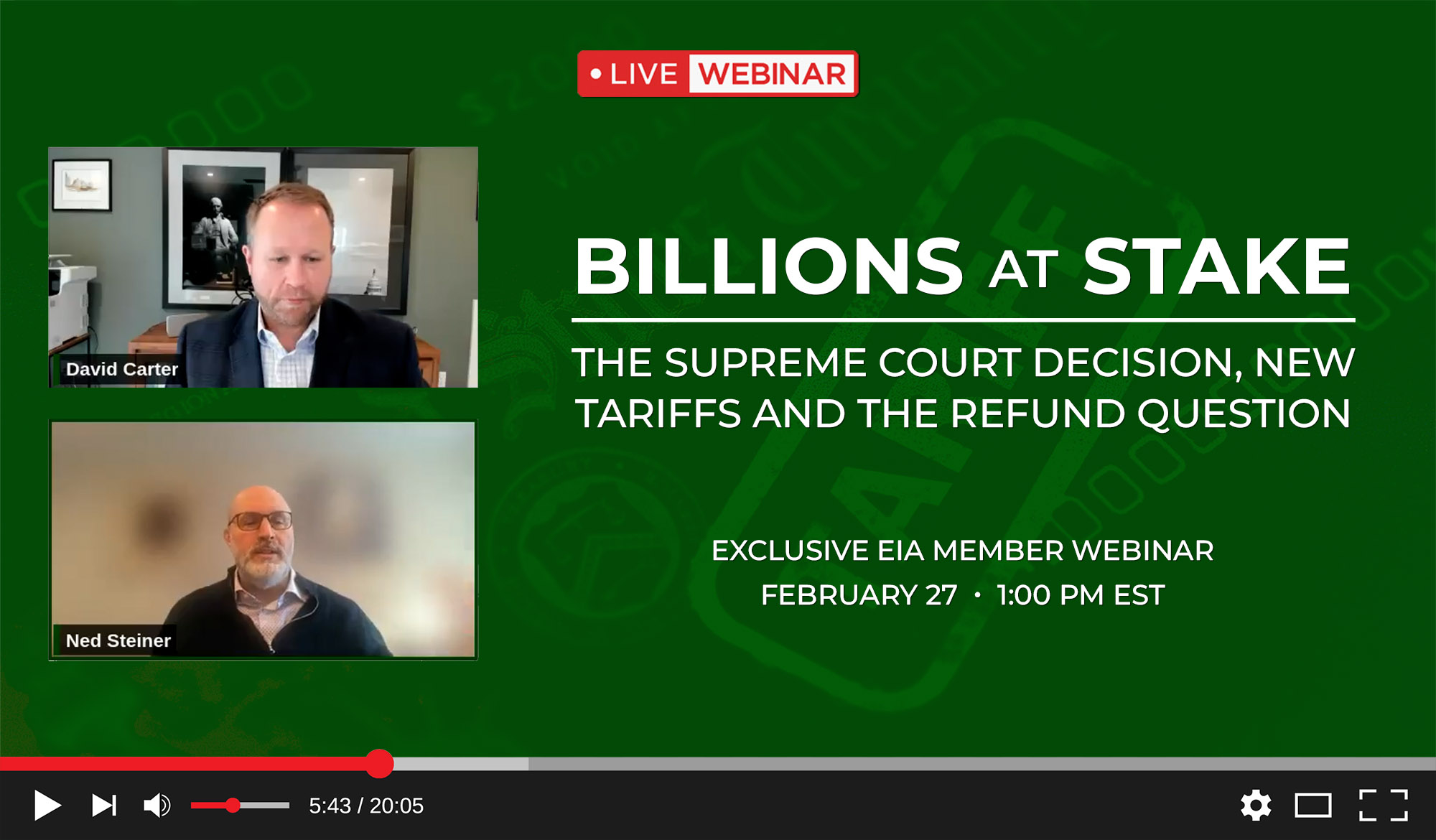
Watch Webinar Replay
Watch the video replay of our webinar “Billions at Stake: The Supreme Court Decision, New Tariffs and the Refund Question” to learn more about the recent Supreme Court IEEPA decision. We discuss in detail what the Supreme Court’s decision actually changes, how the Administration has responded since, the pathways for potential refunds and much more.