
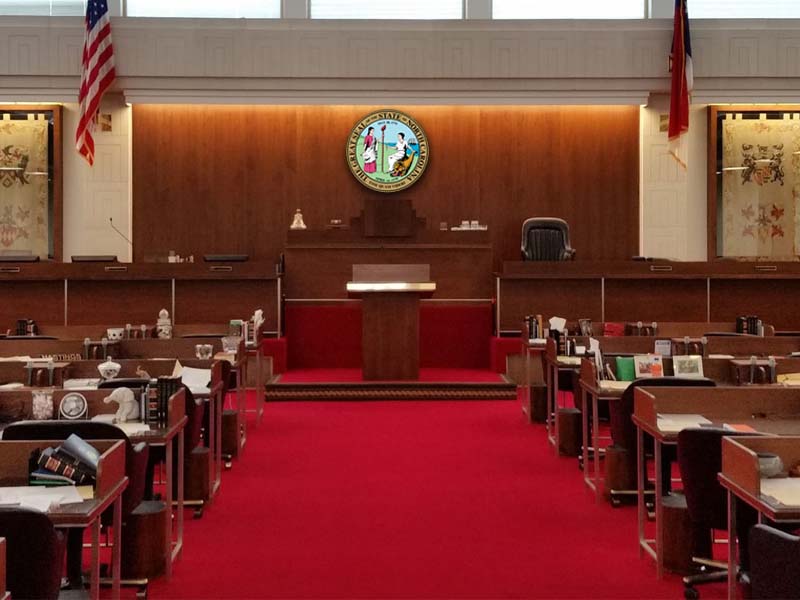
The EIA is closely monitoring developments in North Carolina and can report a critical legislative action today. The North Carolina House of Representatives has reportedly unanimously adopted Amendment No. A to House Bill 936. This amendment eliminates the controversial “one-to-one consent” requirement originally included in the bill. This significant development follows extensive advocacy efforts by the EIA, including speaking directly to the North Carolina House Judiciary 3 Committee yesterday and bringing together a coalition of industry stakeholders to raise serious concerns about the bill’s initial provisions.
HB 936, titled “Robocall Solicitation Modifications,” sought to modify North Carolina’s laws governing telephone solicitations, including robocalls and texts. As the EIA previously highlighted, a key proposed change in the initial draft of the bill was the introduction of a new definition for “Prior express written consent”. This definition appeared to directly mirror the stringent and recently invalidated one-to-one consent requirement previously promulgated by the Federal Communications Commission (FCC) in its 2023 Order.
The FCC’s 2023 Order had attempted to impose two additional restrictions on what constitutes “prior express consent” for telemarketing and advertising robocalls, building upon its 2012 requirement for “prior express written consent” in such cases. These restrictions included the “one-to-one-consent” rule, which declared that a consumer could authorize no more than one identified seller at a time to make telemarketing or advertising robocalls, effectively requiring separate consent for each individual caller. The other was the “logically-and-topically-related” restriction, attempting to limit consent to calls whose subject matter was logically and topically related to the context in which consent was given.
However, the 11th Circuit Court of Appeals recently vacated Part III.D of the FCC’s 2023 Order, finding that these additional restrictions exceeded the FCC’s statutory authority under the Telephone Consumer Protection Act (TCPA). The court determined that the FCC’s restrictions impermissibly conflicted with the ordinary statutory meaning of “prior express consent” in the TCPA. The court noted that the TCPA requires only “prior express consent,” not “prior express consent plus,” and that the FCC’s authority to “implement” the TCPA does not grant it the power to alter the specific choices Congress made or decree duties the statute does not require. Under common law principles, which the 11th Circuit has held govern the interpretation of “prior express consent” under the TCPA, consent is a voluntary willingness for certain conduct to occur and is clearly and unmistakably stated, depending heavily on the facts of each case. The court explicitly found that one-to-one consent is not required under the ordinary meaning of “prior express consent”.
The EIA and other industry stakeholders raised significant concerns that HB 936, in its original form, sought to “reincarnate” this invalidated federal standard at the state level. The proposed state-level one-to-one consent requirement posed substantial compliance challenges for businesses operating nationwide, particularly concerning the ability to reliably determine a consumer’s real-time physical location. Federal regulations, specifically those governing Customer Proprietary Network Information (CPNI), strictly limit the ability of carriers to share real-time location data with third parties, including businesses making calls or sending texts. This regulatory constraint means businesses often cannot know where a mobile subscriber is located at the precise moment a communication is sent.
The original HB 936 attempted to address location with a rebuttable presumption that a North Carolina area code indicates presence within the state. However, the EIA argued that relying solely on area codes, which may be outdated, is problematic. Businesses may possess conflicting location data points (like billing addresses or IP addresses), and the bill offered no guidance on resolving these conflicts. This ambiguity could effectively weaponize conflicting data against businesses, making the presumption nearly impossible to reliably rebut and increasing litigation risk.
Furthermore, the mobility of consumers across state lines creates a situation where a consumer could provide valid consent under federal law while outside North Carolina, but if they subsequently travel into North Carolina, receiving a call or text based on that consent could violate the state’s one-to-one rule, even though the business cannot legally verify the consumer’s real-time location. This potential to create liability for lawful activities conducted across state lines based on inaccessible, real-time geographic factors raised concerns that HB 936 could be seen as improperly burdening interstate commerce.
The EIA, a nonprofit trade association advocating for common sense policies that strengthen the ecommerce ecosystem while protecting consumer privacy, actively engaged with North Carolina legislators to explain these practical and legal barriers. Our testimony yesterday before the House Judiciary 3 Committee, coupled with the collective concerns expressed by industry stakeholders brought together by the EIA, highlighted the potential for regulatory fragmentation, legal uncertainty, and significant compliance burdens for businesses acting in good faith under existing federal frameworks. The North Carolina House has acknowledged these concerns and taken action to remove the problematic one-to-one consent requirement from HB 936 through a unanimous vote. This reported action is a positive step towards aligning state regulations with federal law following the 11th Circuit’s ruling and mitigating the severe compliance challenges businesses would have faced.
The EIA remains committed to advocating for harmonized solutions that effectively protect consumers without imposing unworkable or potentially unconstitutional burdens on businesses engaged in interstate communication. We will continue to monitor HB 936 as it progresses through the legislative process and engage with policymakers to ensure regulations are clear, consistent, and practical.