

The AI Disclosure Bill Merchants Should Be Watching: A Look at the QUIET Act Ahead of This Week’s Subcommittee Hearing
July 20, 2026
On Wednesday, July 22nd, the House Energy & Commerce Subcommittee on Communications and Technology will hold a legislative hearing titled "Protecting Communications Networks and Improving Connectivity" in 2123 Rayburn. Chairmen Brett Guthrie (KY-02) and Richard Hudson (NC-09) announced the hearing on July 15, framing it around three goals: protecting Americans from foreign threats like China, cracking down on illegal robocalls and scammers, and expanding broadband access.…
READ FULL POST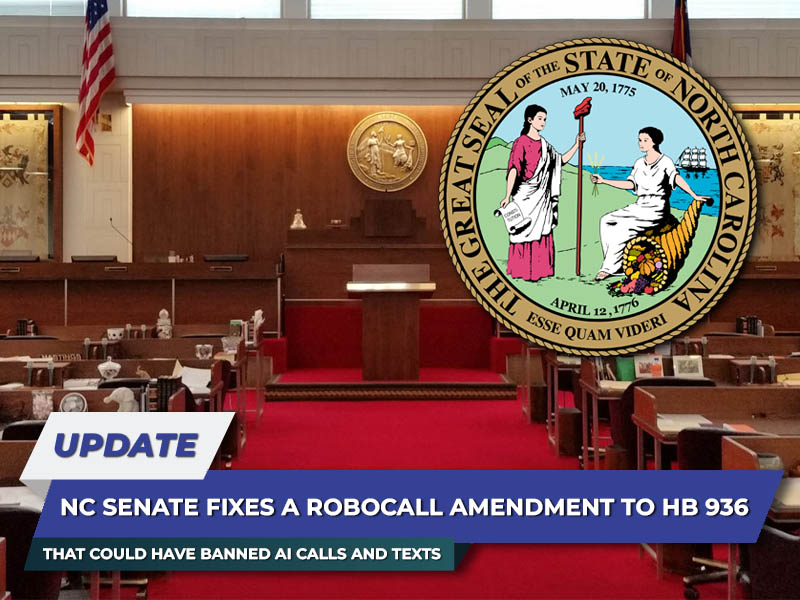
NC Senate Fixes a Last-Minute Robocall Amendment to HB 936 That Could Have Banned AI Calls and Texts — Even With Consumer Consent
June 18, 2026
When the North Carolina House sent House Bill 936, “Robocall Solicitation Modifications,” to the Senate last year, it did so unanimously — 110-0. The bill that left the House was a measured update to the state’s telephone solicitation laws, and the House had already worked with EIA and other business groups to adopt an amendment removing the problematic one-to-one consent requirement we wrote about previously. It looked like a clean story.…
READ FULL POST
65 TCPA Lawsuits, One Destroyed Computer, and a Federal Judge Who Had Enough
April 13, 2026
A Missouri federal court's devastating 26-page sanctions order in Human v. Fisher Investments offers a rare, detailed look at the predatory litigation model that has become a growing threat to legitimate businesses — including ecommerce merchants. Last week, Judge Matthew T. Schelp of the U.S. District Court for the Eastern District of Missouri issued one of the most striking TCPA sanctions orders in recent memory…
READ FULL POST

Beyond the Fifth Circuit: New Ruling Deepens the Legal Divide on TCPA Written Consent Requirement
March 26, 2026
A Maryland federal ruling reinforces growing uncertainty around “written consent” requirements under the TCPA. Just days after the U.S. Court of Appeals for the Fifth Circuit raised questions about whether prior express consent under the Telephone Consumer Protection Act (TCPA) must be in writing, another court has reached a similar conclusion—this time in a different jurisdiction. In Bradley v. DentalPlans.com, a federal judge in Maryland held that the TCPA does not explicitly require written consent for certain telemarketing communications. …
READ FULL POSTPost categories
- Industry News (6)
- Legal Update (26)
- Legislative Update (88)
- Organization News (5)
- Regulatory Update (68)
REcent Posts
Popular Tags
Ecommerce Innovation Alliance (130) EIA (129) FCC (72) FCC petition (19) Federal Communications Commission (55) Frivolous Lawsuits (20) illegal calls (19) mini-TCPA (26) Notice of Proposed Rulemaking (18) quiet hours (29) robocalls (29) scam phone calls (23) shakedown litigation (27) SMS (37) sms marketing (61) spam calls (29) spam phone calls (20) tariffs (18) TCPA (70) TCPA lawsuits (21) Telephone Consumer Protection Act (54) text messages (41) text messaging (33) text messaging laws (23) tracking technologies (20)
The FCC Just Proposed New Rules About Offshore Call Centers and Robocall Crackdowns — But Most of It Isn’t About You (Yet)
Ecommerce Innovation Alliance
March 31, 2026
The FCC eleased two significant Notices of Proposed Rulemaking (NPRMs) on March 27, 2026, both adopted March 26, 2026. While neither is specifically directed at ecommerce companies, the proposals could carry real implications for how online retailers and direct-to-consumer brands will communicate with customers — and how the infrastructure underlying those communications is regulated. Here is a plain-language breakdown of what the FCC is proposing, what's still just a question being asked, and where ecommerce operators should pay close attention.…
READ FULL POST