
If 2024 was the year of “wait and see,” 2025 was the year of the full court press. From the halls of the Texas Capitol to the U.S. Court of International Trade, the regulatory landscape for ecommerce shifted significantly this year. We saw a surge in “mini-TCPA” laws, a foundational rewrite of global trade policy, and a new frontier of privacy mandates.
But 2025 wasn’t just about threats—it was about wins.
The Ecommerce Innovation Alliance (EIA) didn’t just watch these changes happen; we worked with our members to shape them. From defensive blocking to proactive litigation and legislative drafting, we secured landmark victories that preserved billions in value for the ecommerce industry.
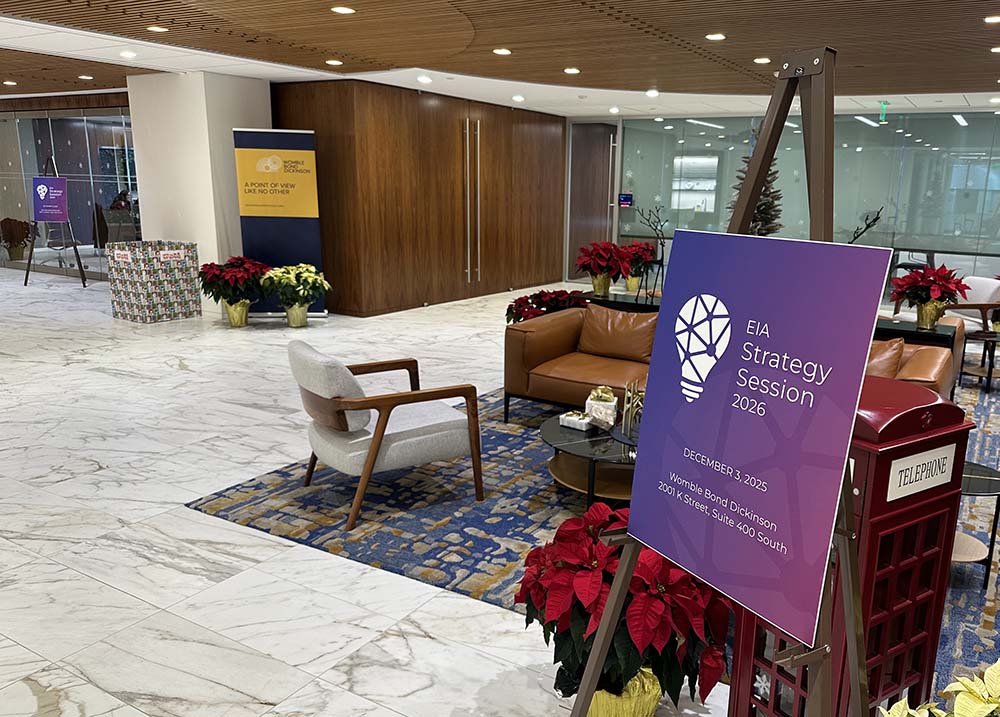
TOP 10 Issues EIA Fought
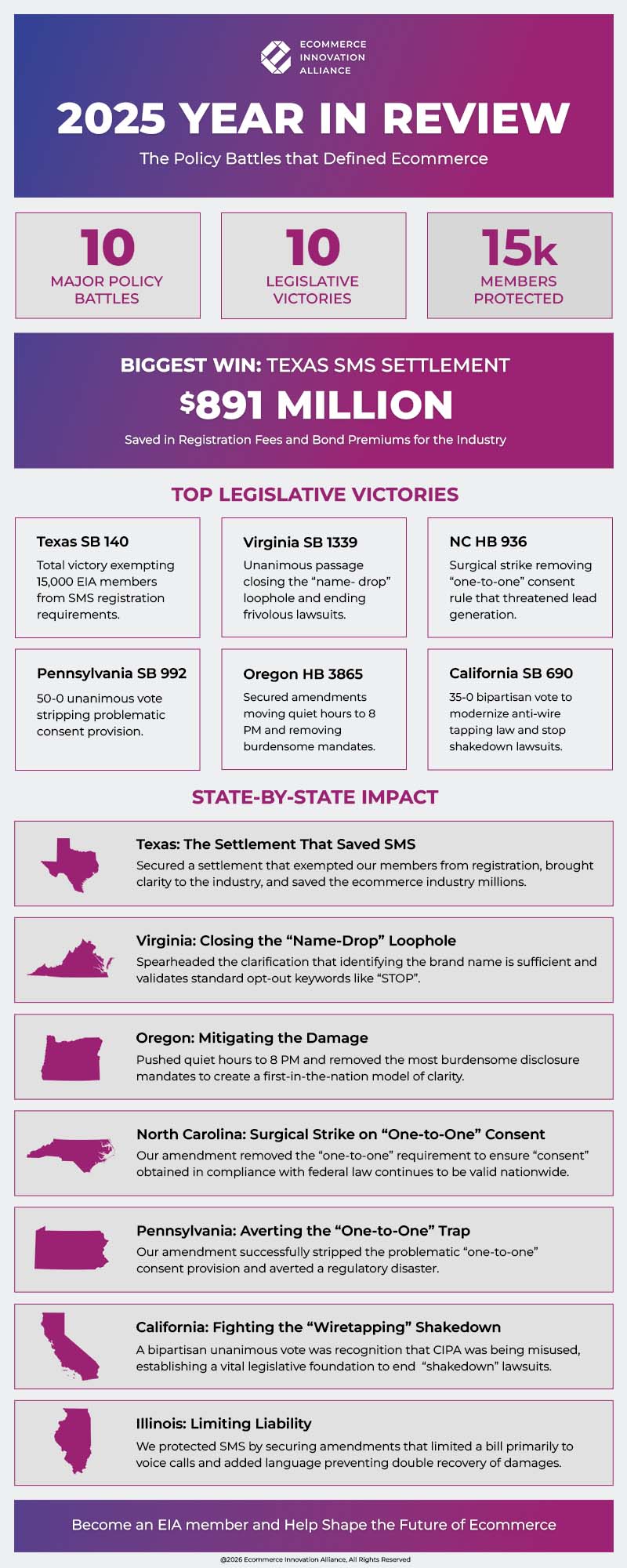
Top 10 Policy Issues that Impacted Ecommerce in 2025 and how the EIA Fought to Protect your Business
1. Texas SB 140: The Settlement That Saved SMS
The Issue: On September 1, Texas Senate Bill 140 took effect, creating a “panic” across the industry. The law appeared to classify all marketing texts as “telephone solicitations,” requiring brands to post a $10,000 bond, pay registration fees, and expose sensitive owner data publicly.
The EIA Impact: We didn’t just advise compliance; we understood the real impact on ecommerce businesses and sued to protect the industry from the burdens of the poorly-drafted law. Partnering with Postscript and Flux Footwear, we challenged the law’s constitutionality in federal court.
The Win: A total victory. The State of Texas conceded that the law does not apply to businesses sending text messages with prior consumer consent. We secured a settlement that exempted our 15,000 members from the onerous registration regime, brought clarity to the industry as a whole, and saved the ecommerce industry direct costs for the state’s $200 filing fee and the premiums to obtain the $10,000 bonds, in addition to hours of time and countless dollars in legal and consulting fees. With an estimated 1.98 million ecommerce brands sending text messages in the United States, the registration fees and bond premiums would have cost the industry more than $891 million in out of pocket costs to comply with Texas registration requirements. In practice, many businesses would have stopped messaging Texas residents entirely rather than incurring the costs and facing increased risk of litigation.
2. The Fight Against Spam and Scam: Focusing on Technical Solutions
The Issue: For years, the fight against illegal robocalls has relied on a “sue-first” strategy. Regulations like the TCPA created a massive litigation industry targeting legitimate US businesses for technical infractions, while actual scammers—often operating from overseas—continued to bombard American phones with impunity. The result was a lose-lose: consumers were still harassed by fraud, and law-abiding merchants faced “shakedown” lawsuits.
The EIA Impact: The EIA launched an educational campaign to shift the policy focus from litigation to technology with a focus on educating state lawmakers about how technical approaches provided a better pathway for stopping spam and scam calls and texts as compared to the litigation approach where private attorneys are incentivized to go after legitimate businesses operating in the United States, rather than foreign criminal enterprises that are virtually impossible to hold accountable in our courts.
The Win: In 2025, we saw a decisive pivot toward the technical solutions that EIA is advocating for:
- The Senate Commerce Committee unanimously passed the Foreign Robocall Elimination Act, which seeks to create a task force dedicated to technical mitigation strategies like international caller ID authentication.
- The FCC released a new proposal (FCC 25-76) to mandate “Verified Caller Name” and “Rich Call Data” (RCD) technologies. This moves the industry toward a system where consumers can trust the name on their screen, rendering the “litigation trap” obsolete.
- State Attorneys General began focusing energies on the source of the problem, sending cease-and-desist letters to the “gateway” telecom providers that were facilitating illegal traffic.
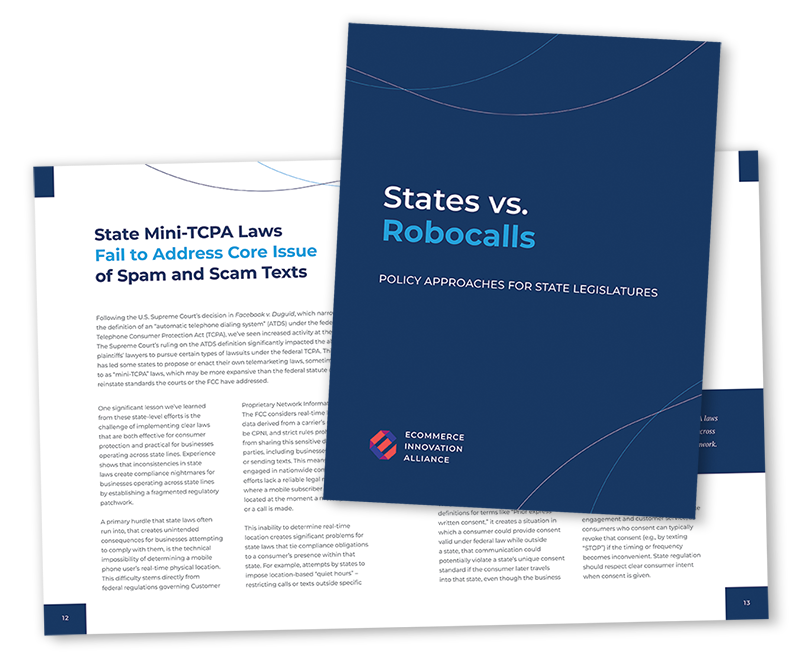
Our 24-page book “States vs. Robocalls: Policy Approaches for State Legislatures” empowers state legislatures to make a real impact by providing a strategic path forward that avoids the pitfalls of individual state “mini-TCPA” laws.
3. Virginia SB 1339: Closing the “Name-Drop” Loophole
The Issue: Virginia’s “mini-TCPA” had become a magnet for frivolous lawsuits. Plaintiffs’ attorneys were suing brands for millions simply for failing to include an individual employee’s “first and last name” in automated marketing texts—a requirement that made no sense for modern ecommerce.
The EIA Impact: We went on the offensive. Instead of fighting each lawsuit, we drafted a bill to fix the broken law and worked tirelessly to get members of both parties to understand the issue and support this important change for small businesses.
The Win: We spearheaded the passage of Senate Bill 1339, which passed unanimously. The new law clarifies that identifying the brand name is sufficient and validates standard opt-out keywords like “STOP,” effectively shutting down a cottage industry of litigation that was targeting ecommerce companies.
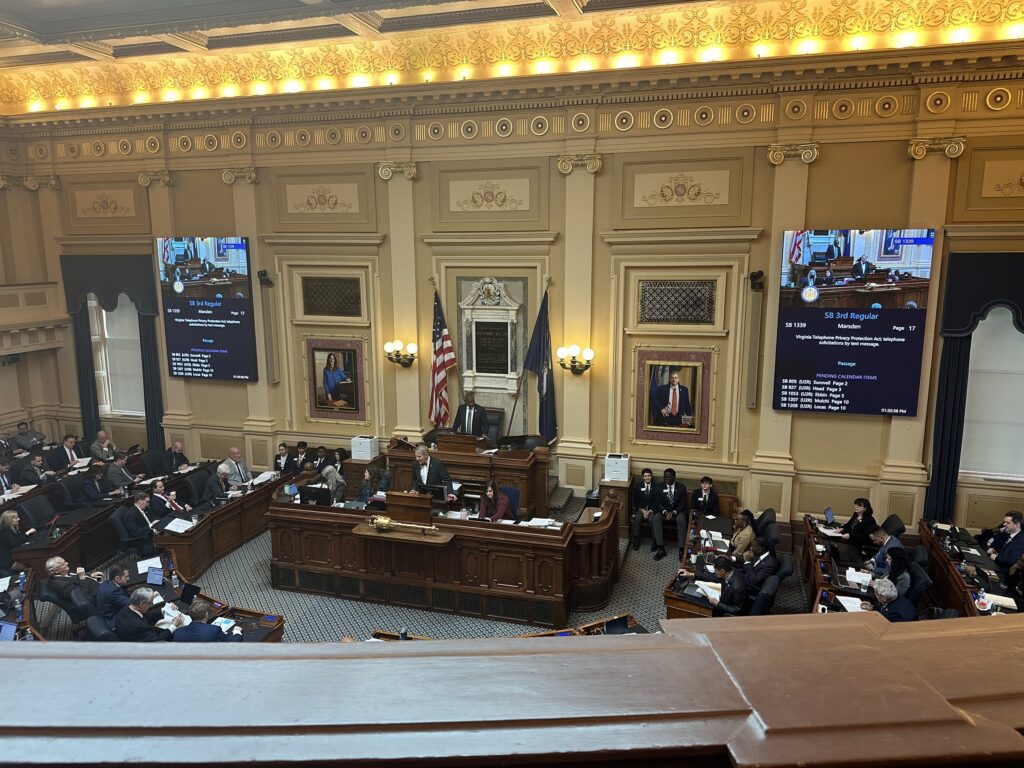
EIA’s Senate Bill 1339 passing with a unanimous vote by both the Virginia Senate and House of Delegates in February of 2025.
4. Oregon HB 3865: Mitigating the Damage
The Issue: Oregon proposed a law with an unworkable 7:00 PM quiet hour curfew and massive disclosure requirements for every single text message and that would have proposed obligations on companies.
The EIA Impact: We assembled a coalition of businesses and trade associations to advocate for changes and testified before the House Committee, explaining how many of the provisions in the bill were unworkable in practice and would fuel litigation against legitimate businesses. We engaged in several substantive meetings with the Bill’s sponsor and the Oregon Attorney General’s office to work on proposed amendments that would provide clarity and address the most egregious provisions of the draft legislation.
The Win: We secured amendments that moved the quiet hours to 8:00 PM and removed the most burdensome disclosure mandates, turning a “business-killing” bill into a manageable compliance standard. We also successfully amended the law to make clear that businesses can rely on a phone’s area code to determine which numbers are impacted by Oregon’s law, providing a first-in-the-nation model of clarity.
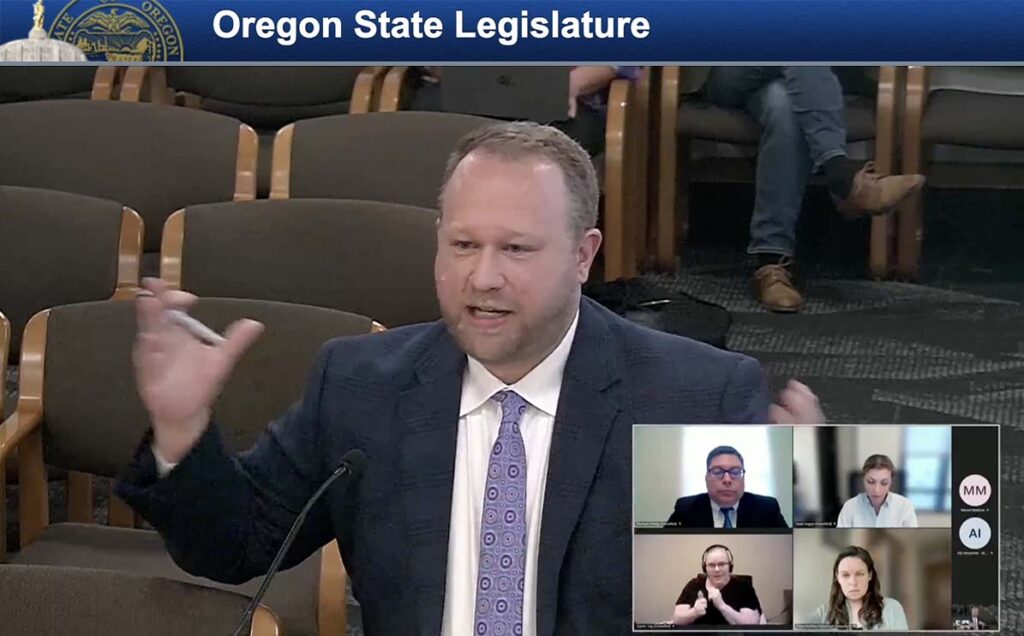
EIA’s President and CEO, David Carter testifying in the Oregon Senate Judiciary Committee on House Bill 3865A in April of 2025.
5. North Carolina HB 936: Surgical Strike on “One-to-One” Consent
The Issue: North Carolina tried to codify a “one-to-one consent” rule, requiring consumers to consent to each specific seller individually. This provision mirrored a controversial Federal Communications Commission (FCC) rule that had already been invalidated by federal courts. This would have destroyed lead-generation and partnership marketing models.
The EIA Impact: Leveraging a recent federal court victory, we lobbied the NC House Judiciary Committee to strip this specific provision.
The Win: The House unanimously adopted our amendment, removing the “one-to-one” requirement while allowing the rest of the bill to pass. A precise, surgical victory that ensures “consent” obtained in compliance with federal law continues to be valid nationwide.
6. Pennsylvania SB 992: Averting the “One-to-One” Trap
The Issue: Late in 2025, Pennsylvania Senate Bill 992 threatened to codify a “one-to-one” consent rule much like what we had already seen proposed in North Carolina. Enacting it at the state level would have created “legal chaos” and unworkable compliance burdens for the state’s ecommerce sector.
The EIA Impact: The EIA engaged directly with state legislators to prevent Pennsylvania from anchoring its statutes to a “failed and legally unsound federal experiment.” We advocated for the specific removal of the “specific and individual” language to ensure the law protected consumers without stifling legitimate commerce.
The Win: A unanimous consensus. On October 28, the Pennsylvania Senate voted 50-0 to approve Amendment A01964, sponsored by Senator Michele Brooks. This amendment successfully stripped the problematic “one-to-one” consent provision from the bill, averting a regulatory disaster and preserving a consistent standard for the industry.
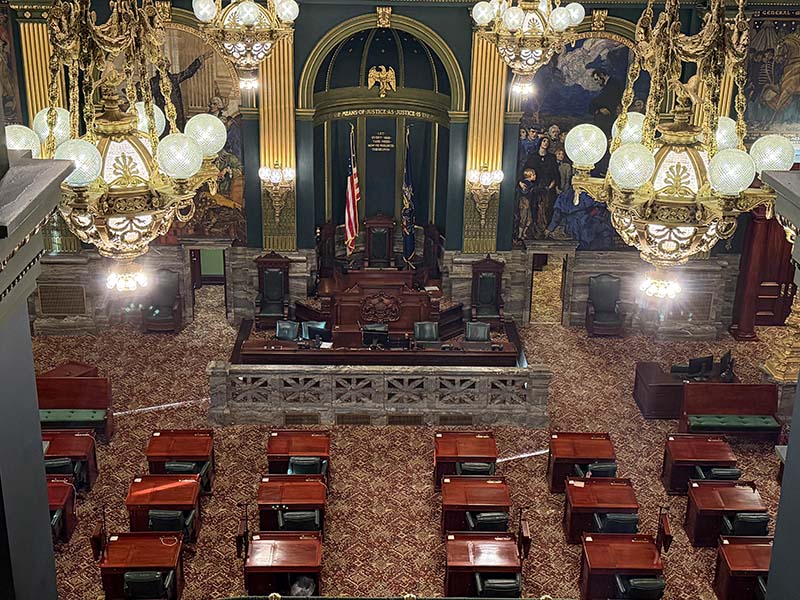
Pennsylvania State Capitol Building Senate Chamber from EIA’s December 2025 visit to discuss SB 992.
7. Trade Wars: The Battle for De Minimis
The Issue: In August, an Executive Order attempted to immediately suspend the de minimis exemption (duty-free entry for shipments under $800) for all countries, using emergency powers under the International Emergency Economic Powers Act (IEEPA). This threatened to instantly increase costs for DTC brands by 20-30%.
The EIA Impact: We filed an amicus curiae brief in the Court of International Trade case Axle of Dearborn v. U.S., arguing the President exceeded his authority by eliminating the de minimis exception without Congressional action and explaining how the exception was a policy established by Congress to promote free trade.
The Win: While the court battle continues, our intervention established a critical evidentiary record of the“irreparable harm” to small businesses, forcing the administration to defend its bypassing of Congress. We anticipate the Court to return to the issue after the Supreme Court weighs in on whether President Trump’s tariffs as a whole exceeded his authority under IEEPA.
8. The “Quiet Hours” Crisis: Taking the Fight to the FCC
The Issue: A wave of nearly 500 class-action lawsuits hit the industry in 2025, targeting brands for sending texts during “quiet hours” (before 8 AM or after 9 PM). The catch? Brands can’t track a mobile user’s real-time time zone, so they were being sued by customers who asked to receive the messages but had moved from one time zone to another or may have been traveling when they received the message.
The EIA Impact: We filed a Petition for Declaratory Ruling with the FCC, urging the Commission to reiterate that “prior express consent” waives quiet hours restrictions and urging reconsideration of its “called party’s location” standard in light of recent decisions to punish wireless carriers for sharing real-time location data for wireless subscribers.
The Win: The FCC moved quickly to seek public comment, and our advocacy has brought considerable attention to the meritless nature of these “shakedown” suits. We await final action from the Commission on our petition.

Social media ads from a South Florida law firm soliciting plaintiffs to file hundreds of lawsuits based on a misapplication of the TCPA.
9. California SB 690: Fighting the “Wiretapping” Shakedown
The Issue: A wave of abusive class-action lawsuits flooded California courts in 2025, weaponizing the California Invasion of Privacy Act (CIPA)—a 1967 anti-wiretapping law—against modern ecommerce. Plaintiffs’ attorneys argued that standard website tools like analytics, chat features, and fraud detection software constituted illegal “eavesdropping” or “wiretapping,” exposing businesses to damages of $5,000 per violation.
The EIA Impact: The EIA threw its full support behind Senate Bill 690 to modernize the statute. We advocated for a clear exemption for data processing done for a “commercial business purpose,” ensuring that legitimate business practices already regulated by the California Consumer Privacy Act (CCPA) could not be twisted into criminal wiretapping claims.
The Win: A bipartisan breakthrough. On June 3, the California Senate voted 35-0 to pass SB 690. This unanimous vote marked a critical legislative recognition that CIPA was being misused. While the bill moved to the Assembly as a “two-year bill” for 2026, the Senate’s overwhelming approval established a vital legislative foundation to end these “shakedown” lawsuits.
10. Illinois HB 2435: Limiting Liability
The Issue: Illinois proposed a new telemarketing law that threatened to double-dip penalties, allowing plaintiffs to sue under both state law and the federal TCPA for the same text.
The EIA Impact: We engaged directly with the bill’s sponsors to narrow the scope.
The Win: We secured amendments that limited the bill primarily to voice calls (protecting SMS) and added language preventing double recovery of damages.
The Bottom Line for 2025
In 2025, the EIA proved that a unified industry voice can stop bad laws and fix broken ones. As we look toward 2026, your membership is more than just a badge—it’s your opportunity to help make policies that protect your business from unintended consequences and crippling costs.
Not a member yet? Join the Alliance today and help us hold the line.