
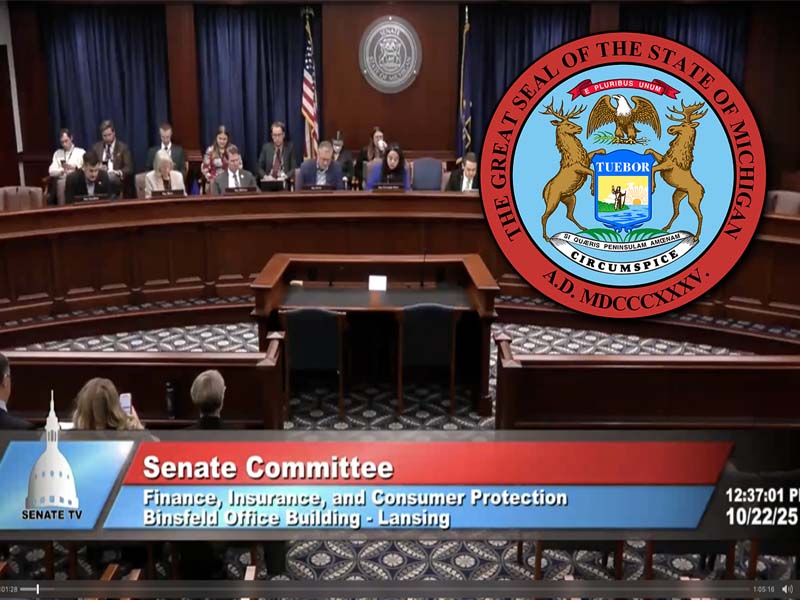
A Shared Goal, A Dangerous Path: Setting the Scene in Lansing
Yesterday, before the Michigan Senate Finance and Consumer Protection Committee, a critical debate unfolded regarding Senate Bill 351, a legislative package aimed at combating the scourge of illegal robocalls and fraudulent text messages. The bill’s sponsor, Committee Chair Mary Cavanagh, and its supporters from the Attorney General’s office rightly identified a problem that plagues every Michigander. On this point, there is universal agreement. The goal of protecting consumers from harassment and fraud is a shared one, a sentiment echoed by all who testified.
However, a panel of industry experts convened by the Ecommerce Innovation Alliance (EIA) delivered a stark warning to the legislature: while the bill’s intent is commendable, its approach is a dangerous and well-documented failure. Testifying before the committee were David Carter, President and CEO of the EIA; Michael O’Rielly, a former Commissioner of the Federal Communications Commission (FCC); and Patrick Brennan of Lending Tree. Their collective message was a plea for Michigan to learn from three decades of federal missteps rather than repeat them.
In his opening remarks, Carter thanked Chair Cavanagh for her willingness to engage in “productive discussions” and consider amendments, establishing a collaborative tone. This spirit of cooperation was reflected in the official stance taken by the witnesses. By formally adopting a “No Position” on the bill, as recorded in the committee minutes, the experts signaled a desire not to obstruct, but to partner. This strategic choice frames their substantive critique not as a rejection of the bill’s goals, but as a constructive offer to help lawmakers avoid predictable pitfalls and craft a more effective law. It is an invitation to fix a flawed blueprint before it causes irreparable harm to the very consumers and legitimate businesses it purports to protect. Watch the full testimony below.
The Cautionary Tale of the TCPA: A Federal Expert’s Warning
Providing a crucial historical perspective was Michael O’Rielly, who served for seven years as an FCC Commissioner after a unanimous Senate confirmation and spent two decades prior helping write and oversee federal telecommunications law. His testimony served as a powerful “cautionary tale” drawn from direct experience overseeing the federal Telephone Consumer Protection Act (TCPA)—the very law SB 351 seeks to replicate at the state level.
O’Rielly warned that “well-intentioned laws, if not written with surgical precision, can create devastating, unintended consequences”. He detailed how the 1991 TCPA, designed to stop abusive telemarketers, “morphed into a weapon used against legitimate organizations conducting routine, and often vital, communications”. He provided the committee with tangible, alarming examples of this overreach. The FCC, he explained, had to issue special rulings just to allow schools to send automated texts to parents about a missing child without facing crippling liability. He described how utilities grew hesitant to send mass alerts about gas leaks and how companies feared sending product recall notifications or flight delay updates—all critical, pro-consumer messages put at risk by a flawed law.
The root of the problem, O’Rielly explained, was the TCPA’s vague language, particularly its definition of an “autodialer.” This ambiguity fueled a “litigation explosion,” with thousands of class-action lawsuits filed not against scammers, but against legitimate businesses for technical violations. This system did little to stop the true criminals, who are often located overseas and immune to U.S. law, but it did enrich a “handful of plaintiffs’ attorneys”. By presenting this history, O’Rielly transformed the debate over SB 351 from a theoretical exercise into an evidence-based one. He offered Michigan the “benefit of hindsight,” demonstrating that the litigation-centric model has a 30-year track record of failure. To support SB 351 as written would be to willfully ignore these well-documented federal mistakes.
Deconstructing the Bill: A Blueprint for Litigation, Not Protection
An examination of SB 351’s text reveals that it is not merely similar to the flawed federal TCPA; it actively resurrects some of its most problematic elements, creating a framework perfectly engineered for litigation abuse rather than consumer protection.
The Overly Broad Autodialer Definition
The bill’s definition of an “Automated Dialing Announcing Device” (ADAD) is dangerously broad, encompassing any device or system used for “automatically selecting or dialing telephone numbers”. This language pointedly ignores the landmark 2021 U.S. Supreme Court decision in Facebook, Inc. v. Duguid. In that case, the Court provided much-needed clarity, ruling that the TCPA’s definition of an autodialer is narrowly limited to devices that use a “random or sequential number generator” to either store or produce telephone numbers to be called. The Court recognized that this specific technology was the tool of indiscriminate, mass-blasting scammers, not of legitimate businesses contacting customers who have consented to be reached.
By reverting to a vague, pre-Duguid standard, SB 351 threatens to classify nearly any modern business communication system—from a smartphone to a sophisticated customer relationship management (CRM) platform—as a prohibited device. This is not a legislative oversight. It is a deliberate choice to create a new, broader path for litigation in Michigan that federal law, as clarified by the nation’s highest court, has already closed.
Incentivizing “Shakedown Lawsuits”
The bill’s enforcement mechanism is what O’Rielly termed a “blueprint for litigation abuse”. It creates a private right of action, allowing individuals to sue for statutory damages of $1,500 per violation, plus reasonable attorney’s fees. Carter noted that the federal TCPA was called the “poster child for lawsuit abuse” by a former FCC Chairman precisely because of this structure.
This model incentivizes what are commonly known as “shakedown lawsuits”. Because a single messaging campaign to thousands of customers could theoretically result in millions of dollars in statutory damages for minor technical infractions, the financial risk of going to court is astronomical. This threat forces legitimate businesses into multi-million-dollar settlements, regardless of whether any actual consumer harm occurred. The primary beneficiaries of this system are not consumers, but the plaintiffs’ attorneys who profit from it. Meanwhile, the actual criminals operating from overseas remain untouched, as it is not economically rational for attorneys to pursue them.
The Impossible Compliance Burden
Certain provisions in SB 351 are simply unworkable, setting a trap for even the most well-intentioned businesses. The “quiet hours” provision, which restricts calls to between 8 a.m. and 9 p.m. local time, is a prime example. To comply, a business would need to know the real-time physical location of a consumer’s mobile phone at the moment a call or text is sent.
However, as O’Rielly testified, federal Customer Proprietary Network Information (CPNI) privacy rules strictly prohibit wireless carriers from sharing that sensitive location data with third parties. This creates a classic catch-22: the bill mandates a standard that federal law makes impossible to meet. It is a provision that guarantees violations, thereby fueling the litigation engine the bill is so expertly designed to create.
The Voice of Business: How SB 351 Threatens Pro-Consumer Communication
David Carter, speaking on behalf of over 15,000 ecommerce companies, including many that employ Michigan residents, translated these technical flaws into real-world consequences. He explained that for modern businesses, text messaging is not a tool for harassment but a “vital channel for customer service and long-term customer engagement”.
These are not unwanted solicitations; they are necessary, consent-based communications that consumers have come to expect and rely on. Carter provided concrete examples:
- Shipping notifications that let a customer know their package has arrived.
- Discount codes that save consumers money.
- Two-factor authentication messages that are critical for keeping online accounts secure.
The deep irony of SB 351 is that in the name of “consumer protection,” it threatens to disable the very communication channels that provide tangible benefits, security, and service to consumers. By creating massive legal liability for sending these messages, the bill incentivizes businesses to curtail or eliminate these communications to avoid risk. The result would be a degraded consumer experience with less security and less information. The presence of Patrick Brennan from Lending Tree at the hearing underscored that these concerns are not limited to retail but are shared across the business community, including financial services, which also rely on timely digital communication.
A Better Way Forward: The Proven Success of a Technology-First Strategy
The most compelling argument against SB 351 is that a far superior, more effective model already exists and is delivering measurable results. Both O’Rielly and Carter detailed how the FCC, under both Democratic and Republican leadership, has shifted its strategy away from a reliance on after-the-fact lawsuits to fighting a “technical war on the front lines: within the telecommunications network itself”.
This proactive, preventative strategy uses sophisticated tools to stop illegal traffic before it ever reaches a consumer’s phone. Key components include:
- STIR/SHAKEN: This technology acts like a “digital fingerprint” to authenticate caller ID information, making it vastly more difficult for scammers to “spoof” or fake phone numbers to trick consumers.
- Traceback Obligations: This creates network-wide accountability by forcing telecommunication providers to trace suspicious calls back to their source and requiring them to block providers who are found to be facilitating illegal traffic.
The success of this technology-first approach is not theoretical; it is proven. As both Carter and O’Rielly testified, since the FCC implemented this strategy, consumer complaints about unwanted calls and texts have fallen by more than 50% in just a few years. This data presents a clear choice for Michigan lawmakers between a litigation-based model with a history of failure and a technology-based model with a demonstrated record of success.
| Feature | SB 351 (Litigation-Centric Model) | FCC (Technology-First Model) |
| Primary Target | Legitimate, domestic businesses due to vague definitions and high-value lawsuits. | International criminal organizations and complicit network providers. |
| Core Mechanism | Reactive, after-the-fact private lawsuits seeking damages. | Proactive, network-level blocking and traffic analysis. |
| Key Tools | Private right of action, $1,500 statutory damages per violation. | STIR/SHAKEN caller ID authentication, mandatory traceback obligations. |
| Proven Outcome | Decades of litigation abuse with minimal impact on scam volume. | A 50% reduction in consumer complaints in just five years. |
Furthermore, Carter noted that the correct way to address the international nature of the problem is through federal action like the bipartisan Foreign Robocall Elimination Act, a bill the EIA strongly supports. This “study before you regulate” approach targets the actual criminals without inflicting collateral damage on legitimate businesses.
The Political Double Standard: Who Is Really Bothering Consumers?
In a striking portion of his testimony, Carter challenged the very premise of the bill by revealing who is truly responsible for the majority of consumer complaints about text messages. He argued that the public frustration driving SB 351 is real but misdirected. The data, he explained, shows that the primary source of unwanted texts is political campaigns.
Citing data from telecommunications carrier AT&T, Carter revealed a staggering statistic: political text messages account for only 7% of messaging traffic but are responsible for an astonishing 60% of all customer complaints. This is not a partisan issue; it is a consumer issue. Polling shows that 90% of Democrats and 85% of Republicans believe political campaigns should be required to get consent before sending texts.
This data exposes a glaring double standard at the heart of SB 351. Indeed, rather than seeking to address consumer frustration with unwanted political calls and texts, the Committee doubled down on insulating politicians from liability by adopting a broad amendment exempting political messaging before public debate on the bill even began.
Carter posed a direct and potent question to the committee: “If the risks and burdens of SB 351 are not too much for small businesses to bear, then why shouldn’t those seeking and holding public office also be willing to meet its requirements and face its consequences?”
A Call for a Smarter Approach for Michigan
The testimony presented yesterday makes it clear that while Senate Bill 351 is born from a laudable goal, its current form is a flawed and counterproductive means of achieving it. It relies on a failed litigation model that has been proven to harm legitimate businesses and chill pro-consumer communication, all while failing to stop the actual criminals.
The Ecommerce Innovation Alliance is not alone in this assessment. A broad coalition of business groups, including the Michigan Chamber of Commerce and CTIA, have also registered their opposition to the bill.
Rather than repeating the mistakes of the past, Michigan has an opportunity to lead. Those who testified on behalf of the business community offered a clear and constructive path forward, urging the committee to adopt three common-sense amendments based on decades of federal experience:
- Adopt a modern autodialer definition that aligns with the U.S. Supreme Court’s standard in Facebook v. Duguid, focusing on the technology that bad actors actually use.
- Focus on bad actors, not good-faith communicators, by requiring a showing of intent to harass or cause actual harm before liability attaches.
- Protect beneficial and constitutionally protected speech by including clear exemptions for the non-commercial, informational messages that consumers want and need and align definitions with the existing federal standards.
The committee has a choice: enact a law that will create a cottage industry for litigation in Michigan or craft a smarter, more effective law that provides real protection for consumers. By embracing a technology-first approach and making these targeted amendments, lawmakers can give law enforcement the tools needed to target criminals while providing clear, fair rules for the legitimate businesses that drive Michigan’s economy.
Join the EIA today to help strengthen and shape policies that affect all ecommerce businesses. Together, we can continue to create the future of ecommerce. Subscribe to EIA email updates to stay informed on key developments and their impact on your business.
Editor’s Note: This post was originally published on October 23, 2025 and has been updated on October 24, 2025 to include the following:
Recent media coverage from Bridge Michigan, WEMU, and WILX News 10 highlights renewed attention to Michigan’s SB 351 and the growing debate around how best to protect consumers while supporting legitimate business communications.