
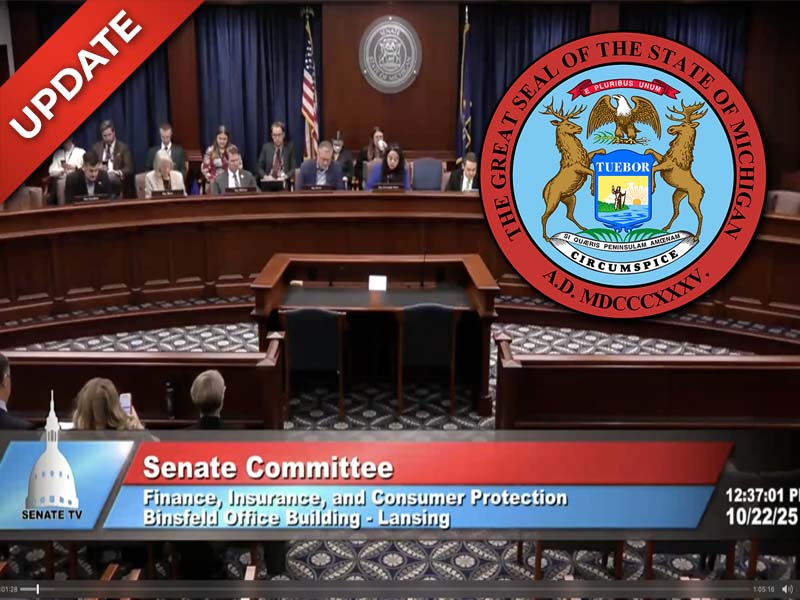
The Ecommerce Innovation Alliance (EIA) is issuing an urgent legislative update regarding Michigan Senate Bill 351, a “Mini-TCPA” bill that was reported out of the Senate Committee on Finance, Insurance, and Consumer Protection on December 3, 2025.
While the stated goal of the bill is to curb illegal robocalls—a goal the EIA and its members fully support—the current text of SB 351 represents a significant threat to legitimate ecommerce businesses in Michigan and beyond, while doing little to stop actual scammers.
Why EIA Opposes SB 351
The EIA opposes the advancement of this bill in its current form due to critical flaws that will punish law-abiding businesses rather than interrupting the criminal enterprises that scam American consumers out of their hard-earned money:
- A “Blueprint for Litigation Abuse”: The bill includes a broad private right of action with statutory damages. As we have seen in other states, private lawyers are neither equipped nor inclined to spend time or resources to try to unwind the complex web of criminal enterprises – largely based in foreign countries – who use calls and text messages to impersonate legitimate companies to engage in scams. Instead, these lawyers focus their energy on domestic businesses, including small and mid-size businesses, where they can use the sheer costs of litigation as a tool to extract settlement payments even for meritless claims. Similar private rights of action, coupled with strict liability, has created a cottage industry for class-action lawsuits targeting legitimate companies, rather than stopping the “bad actors” who ignore the law entirely. Meanwhile, the private right of action does nothing to curb the real harms.
- Conflicts with Existing Law: The bill creates numerous conflicts with existing federal standards and state laws, layering confusion on top of an already complex regulatory environment. These conflicting obligations drive up compliance costs for small businesses and are the precise areas that will be exploited to fuel opportunistic litigation.
- Harm to Small Businesses: By subjecting businesses to strict” liability, even for inadvertent errors, SB 351 threatens the viability of small and medium-sized e-commerce companies that rely on standard communication tools to reach their customers.
Your Immediate Action is Crucial
We have been fighting hard on your behalf, but the voices of individual business owners are incredibly impactful. Michigan legislators need to understand the real-world negative consequences this bill will have on businesses like yours. We strongly urge you to take action IMMEDIATELY, and we have made that easy for you.
Please take a few minutes today to make your voice heard by signing our petition. We are committed to supporting your growth and success, and that includes advocating for a regulatory environment that allows you to thrive.
SIGN OUR PETITION NOWA Refusal to Engage
The EIA and industry experts have made repeated, good-faith efforts to work with the bill’s sponsors to craft amendments that would protect consumers without destroying business viability.
During committee hearings, experts like former FCC Commissioner Michael O’Rielly warned that without “surgical precision,” this law would create “devastating, unintended consequences.” EIA President David Carter testified before the Senate Finance, Insurance, and Consumer Protection Committee, explicitly warning that SB 351 would punish compliant businesses without deterring criminals.
Following this testimony, EIA sent a detailed letter to committee members presenting conclusive data that Mini-TCPA laws do not reduce unwanted calls and texts in the states where they are adopted. The letter highlighted the failure of similar laws in Florida and Oklahoma, where data shows that robocall volumes remained staggeringly high despite the enactment of strict liability statutes. By contrast, states without such laws have seen equal or greater reductions in consumer complaints, largely driven by federal enforcement efforts rather than state litigation traps.
Despite first having optimism that the bill sponsor, Sen. Mary Cavanagh, would consider industry concerns and expertise, that optimism never materialized into the types of changes that would address the unintended consequences identified by EIA. Similar to Michigan’s last legislative cycle, Senator Cavanagh worked closely with the office of Michigan’s Attorney General, Dana Nessel, to craft this legislation. Because of this, EIA also made a good-faith attempt to meet with the Attorney General’s office to show industry’s willingness to collaborate and shape better legislation to provide tools to identify and target scammers and spammers. The Attorney General’s office refused to meet with EIA. As such, the industry’s concerns have gone largely ignored in the version of the bill that was passed out of the Senate Committee on an entirely partisan basis. In addition to the EIA, the committee record shows that the Michigan Chamber of Commerce, the National Federation of Independent Business, and Michigan Realtors have all opposed the current legislation.
By ignoring expert testimony and rejecting common-sense improvements, the Attorney General’s office is pushing legislation that prioritizes headlines over functional consumer protection. The EIA calls on members of the Michigan Senate to reject SB 351 until it is amended to target actual criminals without endangering the state’s legitimate economic engines.
Join the EIA today to help strengthen and shape policies that affect all ecommerce businesses. Together, we can continue to create the future of ecommerce. Subscribe to EIA email updates to stay informed on key developments and their impact on your business.