

Federal Judge Rejects CIPA Pixel Lawsuit Lacking Evidence of Genuine Privacy Harm
July 9, 2026
For the past several years, ecommerce businesses have faced an onslaught of lawsuits targeting the routine use of website analytics and advertising technologies. Plaintiffs' attorneys have increasingly relied on the California Invasion of Privacy Act (CIPA) to argue that common website tracking tools constitute unlawful surveillance, even when they collect only standard browsing information. Many of these lawsuits have followed a familiar pattern: broad allegations, little evidence of actual harm, and significant pressure on businesses to settle rather than endure expensive litigation.…
READ FULL POST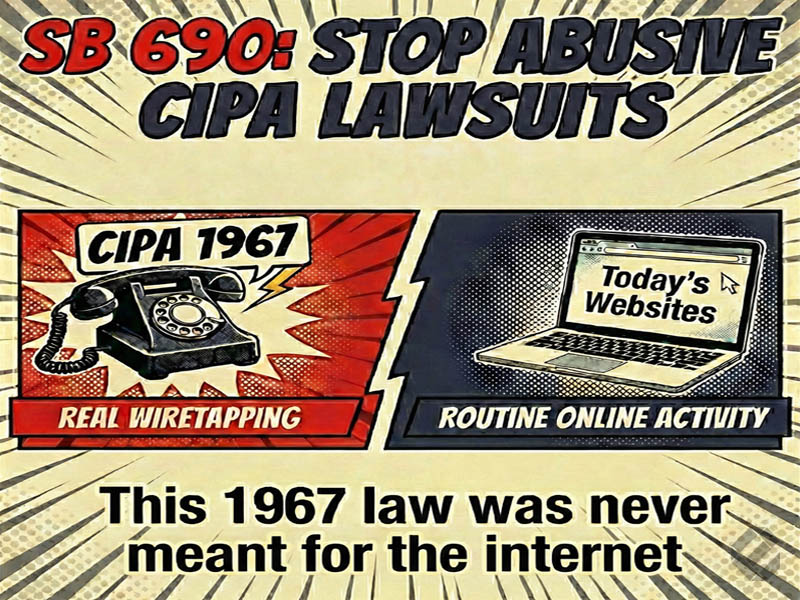
A Major Step Forward: SB 690 Advances Out of Committee to Curb CIPA Shakedowns
July 6, 2026
We have important news to share in the fight against abusive California Invasion of Privacy Act (CIPA) litigation. On July 1, the California Assembly Committee on Privacy and Consumer Protection heard testimony on Senate Bill 690 (SB 690) and, after adopting a set of amendments authored by the bill's sponsor, voted unanimously to advance it. The amended version was re-referred to the Assembly Committee on Appropriations.…
READ FULL POST
65 TCPA Lawsuits, One Destroyed Computer, and a Federal Judge Who Had Enough
April 13, 2026
A Missouri federal court's devastating 26-page sanctions order in Human v. Fisher Investments offers a rare, detailed look at the predatory litigation model that has become a growing threat to legitimate businesses — including ecommerce merchants. Last week, Judge Matthew T. Schelp of the U.S. District Court for the Eastern District of Missouri issued one of the most striking TCPA sanctions orders in recent memory…
READ FULL POST
United Against CIPA Shakedowns: EIA Continues Advocacy in Support of California SB 690
March 20, 2026
At the Ecommerce Innovation Alliance (EIA), we believe that business owners should be able to use standard, modern technology to serve their customers without living in fear of predatory lawsuits. Unfortunately, in California, a 1960s-era privacy law is being twisted into a tool for legal "shakedowns" that target legitimate ecommerce brands. …
READ FULL POST
Federal Court Gives a TCPA Troll a Taste of His Own Medicine: Specialty Medical Inc. v. Mark Dobronski
March 2, 2026
Two powerful TCPA decisions in three days is not a coincidence you get to write about very often. Just 48 hours after a federal magistrate judge in California denied Jamee Desouza's attempt to scrub her employer's name from the record in Desouza v. Ralph Lauren, a federal judge in Michigan issued an opinion that is, if anything, even more consequential for ecommerce brands tired of playing defense against professional plaintiffs. …
READ FULL POST
When the Plaintiff’s Own Exhibit Blows Up Her Argument: Desouza v. Ralph Lauren
February 26, 2026
Every so often, a TCPA case comes along that reads less like a consumer protection dispute and more like a cautionary tale about the cottage industry of professional TCPA litigation — and what can happen when a plaintiff’s own paper trail tells a story she’d rather keep hidden. Desouza v. Ralph Lauren Corporation d/b/a Polo Factory Stores, is exactly that kind of case. On February 24, 2026, a federal magistrate judge denied the plaintiff’s motion for a protective order — a motion that was remarkable not just for what it sought, but for the glaring irony embedded in it.…
READ FULL POSTPost categories
- Industry News (6)
- Legal Update (26)
- Legislative Update (88)
- Organization News (5)
- Regulatory Update (68)
REcent Posts
Popular Tags
Ecommerce Innovation Alliance (130) EIA (129) FCC (72) FCC petition (19) Federal Communications Commission (55) Frivolous Lawsuits (20) illegal calls (19) mini-TCPA (26) Notice of Proposed Rulemaking (18) quiet hours (29) robocalls (29) scam phone calls (23) shakedown litigation (27) SMS (37) sms marketing (61) spam calls (29) spam phone calls (20) tariffs (18) TCPA (70) TCPA lawsuits (21) Telephone Consumer Protection Act (54) text messages (41) text messaging (33) text messaging laws (23) tracking technologies (20)